AI Influencers Are Coming for Your Brand Deals — Here's Your Unfair Advantage
In early 2026, Gucci became the first luxury brand to launch a Sponsored AI Lens on Snapchat — an AI-generated influencer running a full immersive campaign. Not a human. Not a UGC creator. An AI persona, generating content at scale, never asking for payment, never missing a deadline, never posting something off-brand at 2am.
If you're a creator who depends on brand deals, this is not a hypothetical threat anymore.
AI influencers — non-human personas powered by generative AI — are engaging niche audiences at scale, right now. The economics for brands are difficult to argue with: a fraction of the cost, complete creative control, no talent management, no controversy risk. Gucci is not the last brand to go this route. They're the first to do it publicly.
This doesn't mean human creators are finished. But it does mean the era of being paid well for generic sponsored content is ending. And it raises a question every creator needs to answer: what do you have that an AI influencer can't replicate?
What AI Influencers Actually Threaten
To understand the threat clearly, it helps to be specific about which types of brand work are vulnerable.
High risk:
- Generic product placement in Reels and TikToks
- Unboxing and review content with scripted talking points
- Brand awareness campaigns that prioritize reach over authenticity
- Content that brands are really producing for themselves, just using your face as the distribution
Lower risk:
- Content where your personal story, opinion, or expertise is the product
- Long-form content where your personality and thinking are the reason people watch
- Communities built around genuine niche interests where trust is the currency
- Audiences who came to you for you, not for product information
The pattern is clear: the more you're functioning as a distribution channel for someone else's message, the more replaceable you are. The more you're building something that people genuinely seek out because of who you are, the less replaceable you are.
But even that second category has a vulnerability. If your audience lives on a platform that an AI-driven algorithm controls, your reach is still at risk.
The Problem With Audiences You Don't Own
Here's where this conversation intersects with something bigger than just AI influencers.
In 2026, creators are facing a double threat: AI-generated content flooding the feed and making organic discovery harder, and platform algorithms deprioritizing creator content in favor of promoted and AI-generated posts. Instagram's organic reach dropped significantly again in late 2025. TikTok's algorithm has consistently narrowed the organic reach of creator content not boosted by ads.
If your audience exists primarily on platforms — Instagram followers, TikTok fans, YouTube subscribers — you're renting that relationship. You don't control when or whether your content reaches them. You don't have their contact information. If a brand decides an AI influencer is cheaper and good enough for the campaign, and you lose that deal, you have no direct way to reach your audience and offer them something else.
An email list changes that calculation entirely.
What an AI Influencer Can Never Have
An AI influencer has a brand-controlled persona, infinite availability, and zero cost per post. What it doesn't have is a list of 10,000 real people who signed up because they specifically want to hear from you.
An email list is a direct relationship. It's not mediated by an algorithm. It doesn't get deprioritized in a feed. It lands in an inbox that the person checks every day. And it was built because someone chose — actively, explicitly — to stay in touch with you specifically.
That's what AI replaces last. Not the most authentic relationships. Not the most engaged communities. Not the audiences who showed up because they care about the actual person, not just the content format.
The irony of the AI influencer moment is that it makes genuine human connection more valuable, not less. When AI-generated content floods every feed, the signal of a real person with a real perspective who has earned real trust becomes scarcer and more valuable. That scarcity is your competitive advantage — but only if you've built a channel where you can reach those people directly.
The Practical Response
The creators best positioned to weather the AI influencer transition are doing three things differently in 2026:
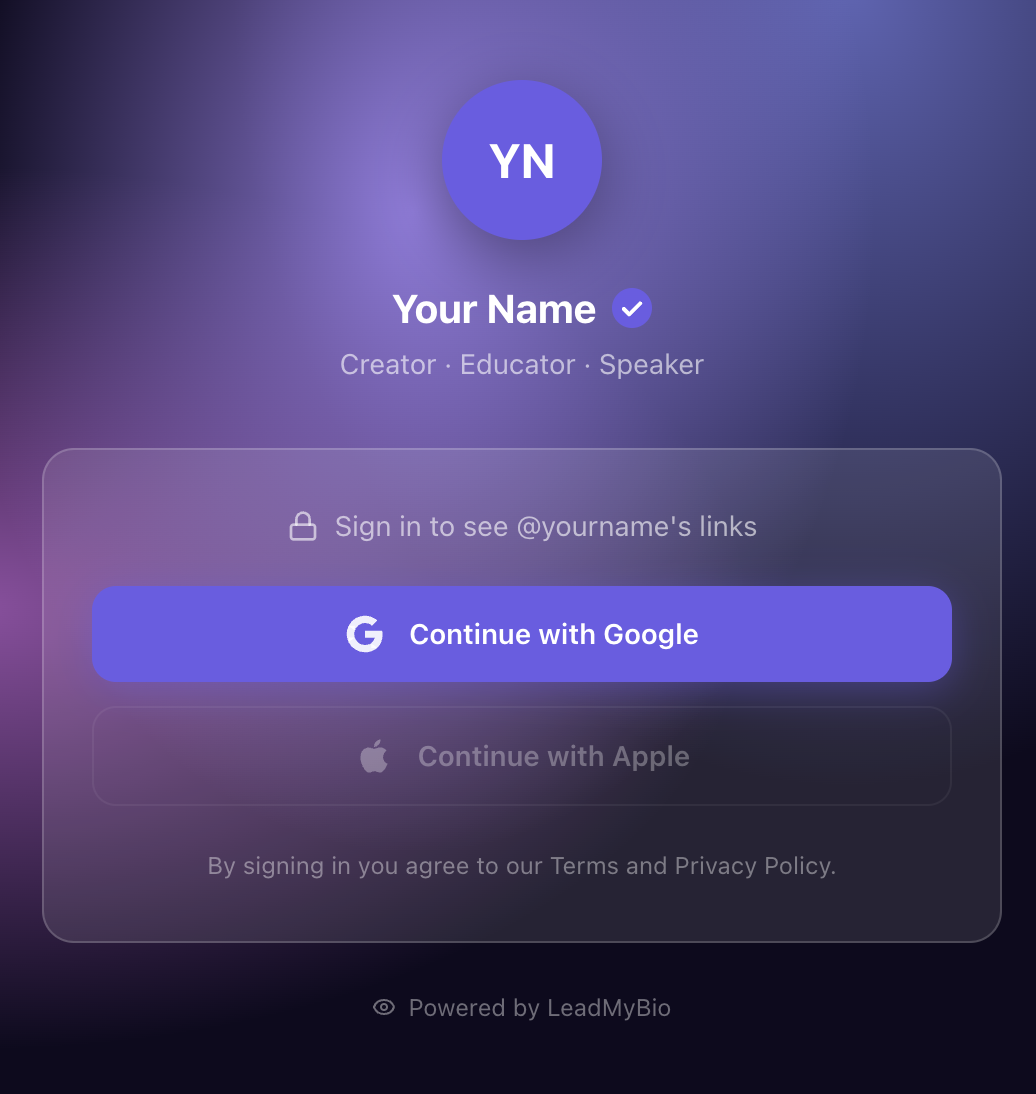
1. Moving faster on email list building. Every piece of content you publish drives potential subscribers to your profile. Most of them leave without giving you any contact information. Converting bio link traffic into verified email subscribers — using low-friction tools like one-tap Google login — is how you build the direct channel while your social following is still growing.
2. Developing genuine expertise and perspective. The more your content is grounded in a specific point of view, real experience, or deep niche knowledge, the less it resembles the generic brand messaging that AI generates well. AI can produce competent product review content at scale. AI cannot produce your lived experience, your specific audience relationships, your earned credibility in a niche.
3. Diversifying away from pure brand deal revenue. Creators who depend entirely on brand deals are most exposed to the AI substitution risk. Creators who monetize through owned products, paid newsletters, community memberships, and digital downloads are building revenue that doesn't require a brand choosing them over an AI.
All three of these converge on the same infrastructure: an owned audience. An email list.
The Window Is Now
The AI influencer trend will accelerate. The economics are too compelling for brands to ignore. The creators who build their email lists in 2026 — before the brand deal market gets further disrupted — will be in a fundamentally different position than the ones who wait.
Your bio link is getting traffic right now. Every post you publish drives people to your profile. The question is whether you're converting any of that traffic into a direct relationship.
One-tap email capture — visitors authenticate with Google and their verified email is captured automatically — converts 15–20% of bio link visitors into email subscribers. Standard forms convert 2–5%. On the same traffic volume, that's the difference between building a small list and building a real asset.
The AI influencer wave isn't going to wait for creators to get organized. The time to build the asset that AI can't replace is before you need it.
Build the audience AI can't steal. Set up your LeadMyBio profile in 5 minutes. Free forever up to 1,000 leads. No credit card required. Create your free profile →
Ready to start capturing real leads?
Set up your LeadMyBio profile in 5 minutes. Free forever up to 1,000 leads.
Create your free profile →