The Creator's Email Launch Strategy: How to Sell Out Without Paid Ads
Two creators launch the same course on the same day.
Same topic. Same price point — $197. Same follower count — roughly 8,000 on Instagram. One of them runs ads, posts daily stories, and pins the announcement to their profile for two weeks straight.
The other creator emails a list.
After seven days, the first creator has sold 3 spots. The second has sold 47.
The only structural difference between those two launches: one creator owned a list of verified contacts who had explicitly signed up to hear from her. The other creator was renting attention from an algorithm that had no incentive to show promotional content to anyone.
This is not a story about talent, niche selection, pricing strategy, or sales page copywriting. It is a story about infrastructure. And in 2026, the creators who understand that email infrastructure is the core of a successful launch are outperforming everyone else by a factor that is difficult to explain away.
Here is the complete playbook.
Why Launches Fail Without Email
The Instagram algorithm in 2026 treats promotional content the way a newspaper treats classified ads — it is technically permitted but actively deprioritized. Organic reach on a standard promotional post averages 5.2% of your follower count. On a post where you are clearly selling something, that number drops further.
So on a 10,000-follower account, your launch announcement is reaching approximately 520 people. Of those, somewhere between 0.1% and 0.3% will click through to a sales page. That is 0.5 to 1.5 buyers from a single post — before you account for people who see the post, are interested, and forget about it entirely because there is no mechanism to follow up.
The deeper problem is urgency. Early bird pricing, cart closing deadlines, bonus removal dates — these urgency mechanisms work when they reach people at the right moment. On social media, you have no control over when your post surfaces in someone's feed. A story announcing that your cart closes in 24 hours might be seen by someone 36 hours after you posted it. The window has passed. The urgency has evaporated.
Email solves both problems simultaneously.
Why Launches Succeed With Email
Average email open rates for engaged creator lists run between 38% and 44%. That is not a typo. More than four in ten people who receive your email will open it. This is because email is a different medium: it is personal, it is direct, it lands in a space the recipient controls, and crucially — they asked for it. They did not passively follow you; they gave you a communication channel.
When you send a launch email, you decide when it arrives. You decide the subject line. You decide whether it lands on a Tuesday morning when your audience is at their desks or a Sunday evening when they are relaxed and browsing. There is no algorithm between you and the inbox.
And when you write a closing email that says "cart closes in two hours," the person reading it knows the cart closes in two hours. The urgency is real because the timing is controlled.
The Pre-Launch Phase: Two Weeks Before Cart Open
Most failed launches begin failing two weeks before cart open. The creator finishes building the product, posts an announcement, and expects the audience to respond to a cold pitch they were not prepared for. The list, if they have one, has been quiet for weeks.
The two weeks before launch are not quiet weeks. They are the most important weeks.
Warming the List
Your pre-launch emails are not sales emails. They are value emails that also happen to prime the reader for what is coming. If your course is about building a freelance photography business, your pre-launch emails might cover:
- The one lens decision that changed your professional career
- A behind-the-scenes breakdown of a paid shoot you did last month
- A raw, personal story about a period when your bookings dried up completely and what you did next
These emails do three things: they remind the reader why they signed up in the first place, they establish your authority on the subject matter of the upcoming launch, and they build emotional investment. The reader arrives at launch day already engaged with the topic.
The Waitlist Email
Before you announce anything publicly — before you post a story, before you share a countdown — send a waitlist email to your list. Tell them something is coming. Give them a chance to raise their hand before the general public knows anything exists.
The subject line can be as simple as: "Something I've been building for three months."
This email does not need to reveal everything. It creates anticipation, it makes your list feel like insiders, and it often generates replies — people asking questions, expressing interest, sharing what problems they are hoping you will address. Those replies are gold. They inform your sales page copy, your FAQ email, and your objection-handling sequence.
Gathering Social Proof Before Launch
In the two weeks before launch, send a short, direct question to your most engaged subscribers: "What is the one thing you struggled most with when you were starting out in [your niche]?" The responses become testimonial material. The specific language people use to describe their problems should appear in your sales emails — not because you are manipulating anyone, but because using the exact words your audience uses to describe their pain is the clearest form of communication possible.
The Launch Sequence
Here is the full seven-day launch sequence that the creator who sold 47 spots used. It is not revolutionary. It is systematic and it works because it maps to how humans make purchasing decisions.
| Day | Purpose | Subject Line Example | |
|---|---|---|---|
| Day 0 | Launch announcement | Introduce the offer, open cart | "It's open. [Course Name] is live." |
| Day 2 | Story / transformation | Show the outcome, make it real | "What changed after I stopped guessing" |
| Day 4 | FAQ / objection handling | Remove friction, address hesitation | "The question I keep getting about [course]" |
| Day 6 | Social proof / testimonials | Third-party validation, build trust | "What happened when [Name] tried this" |
| Day 7 (-24h) | Urgency — closing tomorrow | Create real deadline pressure | "Closing tomorrow at midnight" |
| Day 7 (-2h) | Final call | Last push, no apology | "Two hours left — then it's done" |
Subject Line Strategy
Subject lines for launch emails follow different rules than subject lines for content emails. Here is what works:
Announcement email: Be direct. "It's open." or "[Course Name] is now live." Curiosity-bait subject lines on launch day feel like a bait and switch. Your subscriber was expecting this. Tell them it is here.
Story email: Use the first-person, specific, slightly incomplete sentence. "What I found in my old client files" or "The shoot that almost ended my career." The reader needs a reason to open, not a summary of what is inside.
FAQ email: Use the exact phrasing of a real question. "Can I do this if I only have weekends?" is more compelling than "Your questions answered." It signals to the reader that someone like them already asked this.
Social proof email: Lead with the result, not the process. "From 0 clients to 3 booked shoots in 6 weeks" is a subject line. "See what our students are saying" is a headline for a brochure nobody is going to read.
Urgency emails: State the deadline explicitly. "Closes tomorrow at midnight" beats "Last chance" every time because it is specific. Specific deadlines are credible. Vague urgency is ignored.
The Math of a Real Launch
Run these numbers on your own list size before you dismiss email as "not worth building."
Starting with a modest list of 1,000 verified leads:
- Open rate: 41% = 410 people read your launch emails
- Click-through rate: 22% of openers = ~90 people visit the sales page
- Conversion rate on sales page: 4% = approximately 3.6 buyers per email
- Over a 6-email sequence: compound effect means closer to 4–5% of the total list converts
- Result: 40–50 buyers at $197 = $7,880–$9,850 from one launch, zero ad spend
For context, a paid ad campaign targeting a cold audience at similar conversion rates would cost you $1,500–$3,000 in ad spend to reach the same number of buyers — and those buyers would not end up on a list you own.
At 200 verified leads — which is achievable in weeks with a focused bio link capture strategy — the same math produces 8–10 buyers and roughly $1,576–$1,970. That is a meaningful revenue event from a tiny list, and it scales directly.
At 10,000 verified leads, you are looking at 400–500 buyers per launch. At $197, that is $78,800–$98,500 from a single product launch to a list you built for free.
Scaling the Launch: 200 Leads vs. 10,000 Leads
The sequence does not change as the list grows. The emails are the same. What changes is the absolute number of buyers and, importantly, the leverage.
At 200 leads, every email matters. You will likely know some of these people — they comment on your posts, they reply to your emails, they are part of your core community. Personalization is easy and natural. At this stage, focus on keeping the list warm between launches. A list that hears from you regularly will outperform a larger, colder list every time.
At 10,000 leads, the leverage is dramatic. Small improvements in subject line open rates translate to hundreds of additional readers. A 2-point improvement in sales page conversion rate means dozens of additional buyers. At this scale, testing subject lines (sending the same email with two different subject lines to a 20/20 split, then sending the winner to the remaining 60%) is worth the effort.
The core strategy remains constant at both ends: warm the list before launch, send a structured sequence, use real urgency, let the post-launch email do its job.
The Post-Launch Email
Most creators send the "cart is closed" email and go quiet. This is a significant missed opportunity.
Send a post-launch email within 48 hours of closing. For buyers, this email confirms their decision, delivers any immediate access links or bonuses, and includes one specific ask: share with one person who needs this. Do not ask for a review. Do not ask for a social media post. Ask them to send a message to one friend. Personal referrals from a buyer who is still in the early excitement window convert at dramatically higher rates than any other referral mechanism.
For non-buyers, the post-launch email is not a guilt trip. It is a graceful close that plants a seed. Something like: "Cart is closed — but if you were on the fence and want to know when I do this again, reply and I'll add you to the first-access list." Responses to this email become your highest-priority segment for the next launch. These are people who were interested enough to stay subscribed through a full launch sequence but did not convert — meaning the barrier was timing, price, or hesitation, not disinterest. They are already warm.
How to Build the List Before Your Next Launch
The single most common mistake creators make when they decide to take email seriously: they add a signup form to their Linktree and expect people to fill it in.
Friction kills conversion. A form that asks for a name, email, and confirmation is three steps. Most people who clicked your bio link are on mobile, in a casual browsing state, and will close the tab before they finish typing their email address.
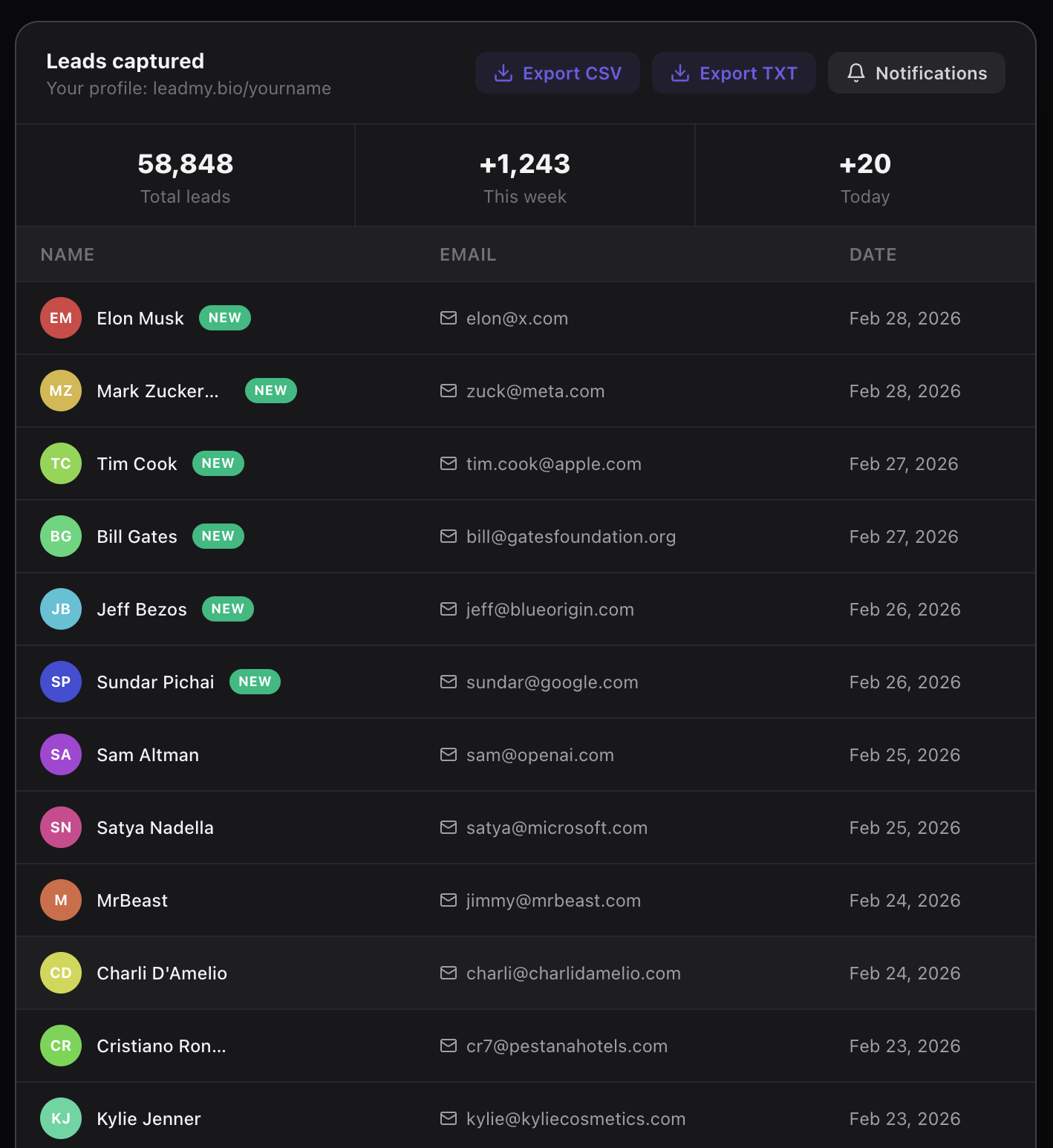
The approach that converts at 15–20% — compared to 2–5% for forms — is one-tap Google login capture. The visitor sees your bio link page, sees a button that says "Get updates" or "Join the list," taps it, and Google auto-fills their verified email. No typing. No guessing at which email address they use. One tap.
The difference is not incremental. On the same traffic, a bio link with Google login capture builds a list four to seven times faster than a form. And the leads are verified — real addresses from real Google accounts, not typos or throwaway emails someone created to avoid spam.
Every week you drive traffic to a bio link that does not capture emails is a week of audience-building that disappears the moment the follower scrolls past.
The creator who sold 47 spots did not have a better product. She did not have a bigger audience. She did not spend money on ads. She spent the previous four months consistently directing her audience to a bio link that captured their emails with one tap, built a list of people who had actively chosen to stay in contact with her, and then ran a systematic seven-email sequence when she was ready to launch.
That is the entire playbook. Infrastructure first. Sequence second. The product just has to be good.
Ready to stop renting your audience? Set up your LeadMyBio profile in 5 minutes. Free forever up to 1,000 leads. No credit card required. Create your free profile →
Ready to start capturing real leads?
Set up your LeadMyBio profile in 5 minutes. Free forever up to 1,000 leads.
Create your free profile →