Fansly vs OnlyFans: Which Platform Is Better for Building Your Email List?
The debate between Fansly and OnlyFans has been running since 2021, when OnlyFans briefly threatened to ban explicit content and creators started looking for alternatives in a panic. Fansly became the most serious contender. Both platforms have matured since then, and the comparison has gotten more nuanced.
But most comparisons focus on commission rates, features, and discovery tools — and miss the question that actually determines long-term creator income: which platform helps you own your audience?
The answer to that question is neither. And understanding why changes how you should think about both.
The Surface Comparison
OnlyFans and Fansly are more similar than different, but the differences matter.
Commission: OnlyFans takes 20% of all creator earnings. Fansly takes 20% as well. No advantage either way — both platforms extract the same cut from every subscription, tip, and pay-per-view sale.
Content flexibility: OnlyFans has stricter content policies and a more complex review process for verification. Fansly has historically been more permissive with content types and has a reputation among creators for more consistent moderation. For creators whose content sits in gray areas, this distinction is significant.
Discovery: OnlyFans offers almost no native discovery. New creators have no organic path to audience growth through the platform itself — you bring your own traffic. Fansly introduced a following/recommendation system that gives creators some discoverability within the platform's ecosystem. It's not Instagram, but it's more than zero.
Payment options: OnlyFans processes through Stripe and has had periodic issues with payment processors pulling support. Fansly processes through multiple gateways and has been more stable for creators in certain regions. Both platforms pay out reliably to established creators — but Fansly has a broader international payment infrastructure.
Creator tools: Fansly offers scheduling, bundled subscriptions, free and paid tiers on the same account, and a more flexible content organization system. OnlyFans has a larger existing subscriber base and stronger brand recognition outside the creator community.
For most creators, the practical decision between the two comes down to content type, existing audience location, and payment reliability in your region. Both are legitimate platforms. Neither is obviously superior in every dimension.
The Question Nobody Asks
Here's what the Fansly vs OnlyFans comparison almost never addresses: when you leave either platform — voluntarily, because of a ban, or because the platform changes its terms — how many of your fans come with you?
The answer is determined entirely by whether you have contact information that exists outside the platform.
OnlyFans subscriber counts, Fansly subscriber counts, tip totals, message histories — all of it lives inside the platform's infrastructure. You access your fans through their interface. You contact them through their messaging system. You retain them through their subscription engine.
If the platform suspends your account tomorrow, you lose access to every one of those relationships simultaneously. You have no names, no emails, no way to reach the people who have been paying you for years.
What the 2021 Policy Scare Actually Revealed
On August 19, 2021, OnlyFans announced a ban on sexually explicit content effective October 1. The decision was reversed ten days later. But those ten days exposed a structural fault line in the entire creator subscription model.
Creators who had email lists sent a message to their subscribers the same day the announcement dropped. They explained what was happening, shared where they were going, and gave fans a direct path to follow them off-platform.
Creators without email lists had no equivalent move. Their subscriber base was a number in an OnlyFans dashboard — visible, but unreachable from anywhere outside the platform. If the ban had held, that number would have meant nothing.
The reversal saved a lot of creators from finding out how fragile their business actually was. The structural problem it revealed — that platform subscriber counts are not owned audiences — did not go away when the policy changed.
Rented Audiences vs Owned Audiences
Both OnlyFans and Fansly operate on the same model: you bring the audience, they provide the infrastructure, and they retain the underlying data. Your subscriber list is a view into their database. You don't have the export. You don't have the emails. You don't have the contact information.
This is not unique to subscription platforms. Instagram, TikTok, and Twitter work the same way. Every follower count on every platform is a rented audience — you can reach them as long as the platform lets you, through the mechanisms the platform controls.
An email list is different. An email address is a contact that exists outside every platform simultaneously. You can import it into any email provider, send from any domain, and reach that person regardless of what any platform decides. The relationship is yours.
The metrics reflect this difference. Average email open rate: 41%. Average organic Instagram reach for a creator account: 5.2%. The same announcement sent to an email list of 10,000 reaches roughly 4,100 people. Posted to 10,000 Instagram followers, it reaches about 520.
The Comparison Table That Actually Matters
| OnlyFans | Fansly | Email List | |
|---|---|---|---|
| Ownership | Platform owns data | Platform owns data | You own it |
| Portability | Not exportable | Not exportable | Export anytime |
| Reach rate | Via platform only | Via platform only | 41% open rate |
| Algorithm dependence | High | Medium | None |
| Survives account ban | No | No | Yes |
| Works across platforms | No | No | Yes |
| Cost | 20% commission | 20% commission | Free to build |
The platforms are competing on commission, features, and discovery. The email list is playing a different game entirely — it's the layer that makes any platform choice survivable.
The Strategy That Works With Both
An email list is not a reason to choose Fansly over OnlyFans or vice versa. It's a complement to whichever platform you use — or both simultaneously.
Many creators run Fansly and OnlyFans in parallel, using different pricing tiers or content strategies for each. An email list serves both. When you announce a new tier on OnlyFans, you email your list. When you launch a Fansly exclusive, you email your list. When either platform has a disruption, your list is how you keep your audience intact.
The mechanics of building the list are the same regardless of which platforms you're on. Your Instagram bio, TikTok bio, and Twitter bio are generating clicks every day. Most of those visitors remain anonymous — you get the traffic, but not the contact information.
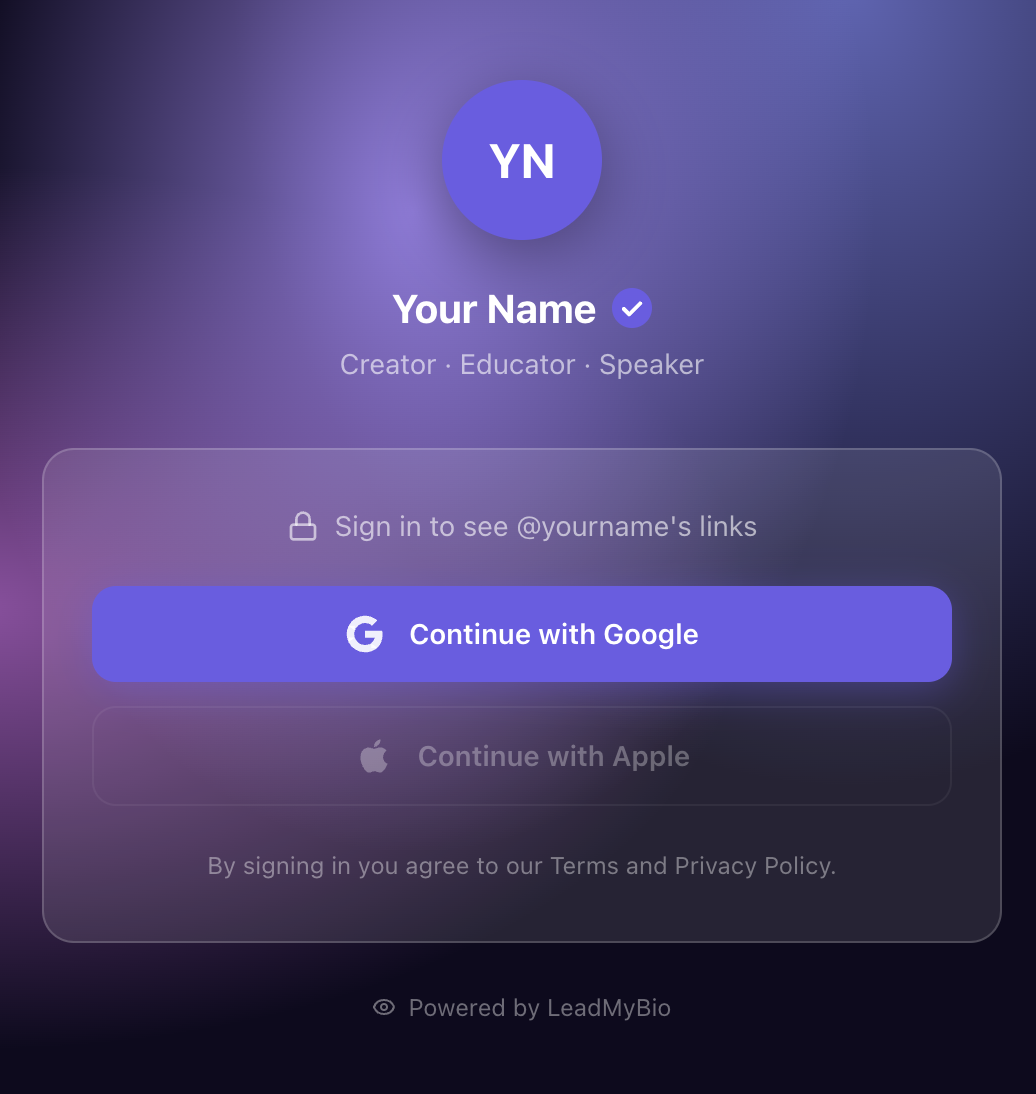
Replace your standard bio link with a LeadMyBio profile. Visitors arrive, see your platform links — OnlyFans, Fansly, whatever you want to display — and authenticate with Google before clicking through. One tap on mobile. Their verified name and email go into your list.
Why Google Login Converts
A standard email form on a landing page converts 2–5% of visitors. Google login converts 15–20%.
The difference is friction. Typing an email address, choosing whether to use a real one or a throwaway, worrying about spam — these are micro-barriers that most people don't clear. A Google login tap takes less than two seconds and carries the implicit assurance that the email being captured is real and active.
For creators, this matters in two ways. First, you're building your list faster. Second, the emails you're capturing are verified — they're real Google accounts, not abandoned addresses or typos.
A bio link getting 500 clicks per month at 15% conversion rate adds 75 verified email subscribers per month. Over a year, that's 900 people who actively wanted to find you and authenticated to do it. Not scraped contacts. Not purchased lists. Real fans.
The Answer to the Original Question
Fansly vs OnlyFans: which is better for building your email list?
Neither. Both platforms are designed to keep subscriber relationships inside their own infrastructure. They're subscription platforms, not email list builders. That's not a criticism — it's a product decision. They monetize through the subscription flow, so the subscription relationship stays in their system.
The email list is built separately, in parallel, from the traffic that passes through your bio links before it ever reaches either platform. It's not an alternative to Fansly or OnlyFans — it's the insurance policy that makes either one work as a sustainable long-term business.
Use whatever platform your audience is on. Charge what your content is worth. Optimize for the features that matter to your workflow. And capture the email address of every fan who clicks your bio link before the platform ever sees them.
The platform is where you monetize. The email list is what you own.
Ready to stop renting your audience? Set up your LeadMyBio profile in 5 minutes. Free forever up to 1,000 leads. No credit card required. Create your free profile →
Ready to start capturing real leads?
Set up your LeadMyBio profile in 5 minutes. Free forever up to 1,000 leads.
Create your free profile →