Why Food Creators Need an Email List (And How to Build One From Instagram)
Food is one of the highest-engagement niches on all of Instagram. Recipe videos rack up millions of saves. Step-by-step cooking Reels outperform lifestyle content, travel content, and fashion content in time spent and repeat views. The food audience is large, loyal, and genuinely hungry for more.
And yet food creators are among the most vulnerable to algorithm shifts of any niche on the platform.
The problem isn't reach. It's what happens after reach.
The Saves Problem
When a recipe goes viral on Instagram, one metric skyrockets above all others: saves. People save recipes at a rate that most other content categories can't match. A good pasta dish, a seasonal dessert, a weeknight dinner hack — viewers aren't just tapping like and scrolling on. They're bookmarking it. They plan to come back.
That save count looks great in analytics. It signals intent. It signals genuine interest. It is, by most measures, the highest-quality engagement signal Instagram has.
But a save is not a contact. When someone saves your recipe, you get zero information about who they are. No name. No email. No way to reach them when your next recipe drops, when you launch a cookbook, when you open enrollment for a cooking course, or when an algorithm update buries your content and you need to reach your audience directly.
Instagram organic reach currently sits around 5.2% — meaning even followers who chose to follow you only see roughly 1 in 20 of your posts on a given day. For non-followers who found you through a viral Reel, the chance of seeing your next post is essentially zero.
The save count tells you your content is good. It does not build you an audience you own.
Why Owned Audience Matters More for Food Creators
In some niches, algorithm dependency is annoying. For food creators specifically, it is a structural business problem.
The highest-value monetization paths for food creators all rely on direct, repeated access to your audience:
Recipe ebooks and cookbooks. A well-assembled collection of 30 recipes — themed by season, cuisine, or dietary preference — is a genuinely sellable digital product. But selling a $15–40 ebook through Instagram alone means competing with the algorithm every time you need to drive traffic to the sales page. Email bypasses that entirely. A single email to a warm list of people who have already saved your recipes converts at a rate that no Instagram post can match.
Cooking workshops and online courses. A 4-week cooking course is a $100–300 product. It requires multiple touchpoints before purchase — people need to see you as credible, understand the value, and feel ready to commit. An email sequence handles this naturally. Instagram stories and posts cannot replicate a structured 5-email nurture sequence that walks someone from "I like her recipes" to "I'm buying the course."
Brand deals. This is where having an email list creates a specific financial advantage that most food creators don't talk about. Food and CPG brands increasingly ask for email list metrics during sponsorship negotiations. The reason: email open rates average around 41%, which gives brands a measurable, non-algorithm-dependent reach number to put in their reports. A food creator with 80,000 Instagram followers and a 4,000-person email list with 41% open rates can demonstrate 1,640 guaranteed eyeballs per send — a number a brand can use in an ROI model. Follower counts alone no longer carry the same weight in those conversations.
Affiliate links. Affiliate links in email consistently outperform affiliate links in Instagram bio. The click-through rate on links in email from a warm audience runs significantly higher than the CTR on a link buried behind a third-party link-in-bio tool, especially when the email is contextual — "here's the exact pasta maker I used in this week's recipe" lands very differently in an inbox than it does as one of eight links on a Linktree page.
The Bio Link Is the Bottleneck
Most food creators already have traffic moving from Instagram to their bio link. "Full recipe in my bio" is one of the most-used CTAs in the niche — it appears in Reels captions, stories, and carousels constantly. Viewers are trained to follow it.
The problem is what happens at the other end of that click. The vast majority of food creator bio links go to Linktree or a similar aggregator: a list of links to the full recipe, the YouTube channel, the cookbook shop, the newsletter. The visitor clicks what they came for and leaves. No record of who they were. No way to reach them again.
The bio link is generating traffic. That traffic is producing zero owned contacts.
This is the bottleneck. Not content quality, not audience size, not niche selection. The traffic is already there. It is not being captured.
Why Google Login Changes the Capture Rate
The standard fix for this problem — adding a newsletter sign-up form to your bio link page — does not work well for cold social traffic. Form conversion rates for Instagram visitors run around 2–5%. Most people who click your bio link to get a recipe are not in the mindset to commit to a newsletter. They want the recipe. They will not fill out a form to get to a list of links.
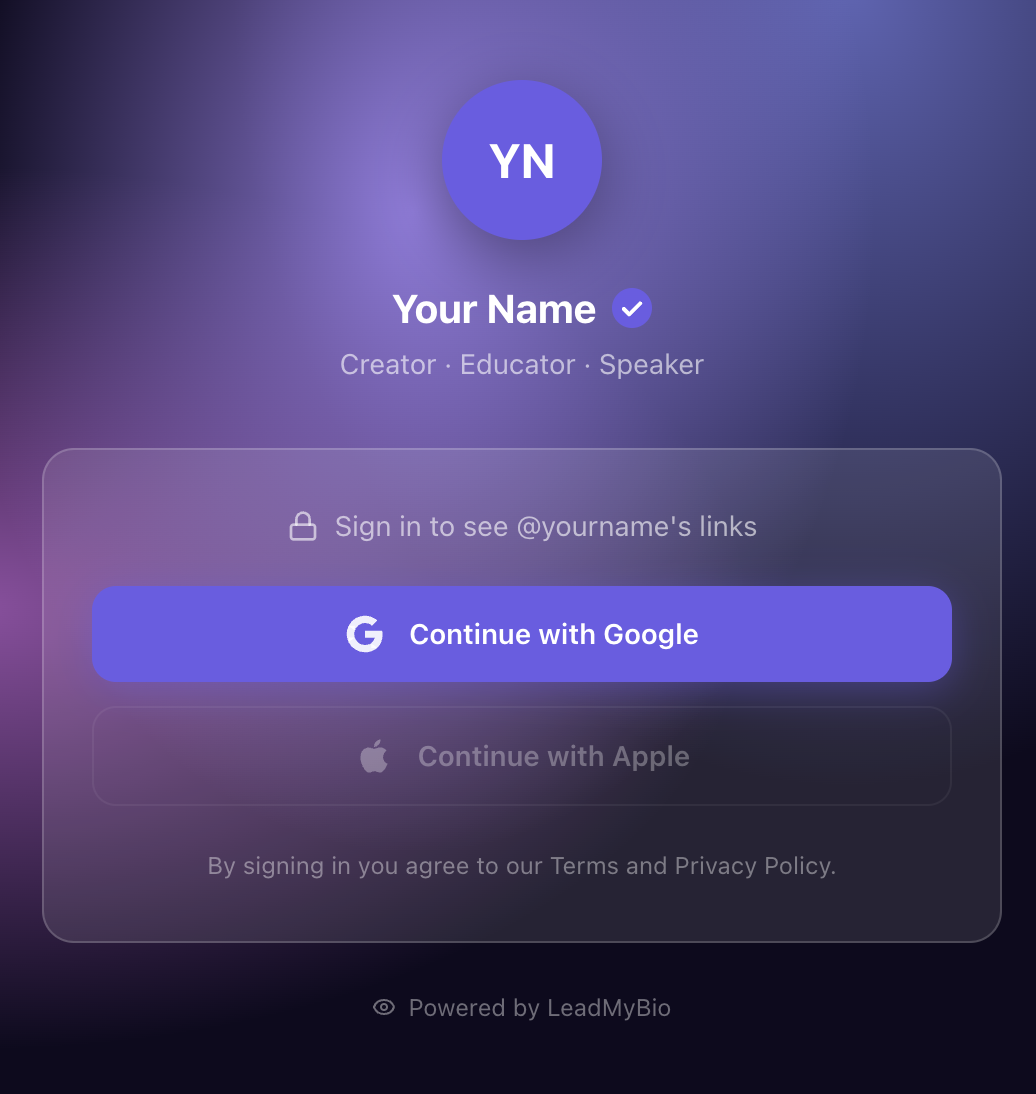
Google login capture works differently. Instead of asking visitors to complete a form before accessing your links, the page presents a one-tap Google sign-in. On mobile — where nearly all Instagram traffic originates — users are typically already logged into their Google account. The login takes under two seconds and requires no typing, no decision about sharing personal data, no friction.
Conversion rates for this model run 15–20%, compared to 2–5% for traditional forms. A food creator getting 200 bio link clicks per week converts 4–10 emails with a form and 30–40 emails with Google login — from the exact same traffic.
The email captured is also verified. It is the email tied to an active Google account — not a throwaway address, not a typo, not an inbox that has not been opened since 2019. Deliverable, real, used.
What the Email List Enables
Once you have a list, the content model that already works on Instagram transfers directly to email — often better.
A weekly newsletter with a featured recipe, a seasonal menu, or a behind-the-scenes look at what you cooked this week is exactly the kind of content food audiences engage with. Email open rates for content newsletters in the food space regularly exceed 40%. The audience that opted in via your bio link has already self-selected as genuinely interested — they did not just double-tap a video while scrolling. They clicked, they authenticated, they said yes to further contact.
Exclusive recipes, early access to your next ebook, seasonal cooking guides available only to subscribers — these are low-effort additions to a newsletter that create meaningful reasons for people to stay subscribed and engaged.
How to Set It Up
The setup takes under five minutes.
- Create a free LeadMyBio profile at leadmy.bio — sign in with Google, pick a username
- Add your links: recipe blog, YouTube, shop, cookbook — whatever you currently have in your bio
- Update your Instagram bio link to
leadmy.bio/yourusername - Keep using "full recipe in bio" and "link in bio" CTAs exactly as you do now
Every visitor who completes the Google login appears in your LeadMyBio dashboard with their verified name and email. Export as CSV at any time. Connect to Mailchimp, Kit (formerly ConvertKit), or any other email platform you use.
The content strategy stays the same. The traffic stays the same. The CTA stays the same. What changes is that the traffic now produces a contact you own permanently, rather than a session you will never see again.
The Compounding Math
Food creators who set this up consistently do not need a viral moment to build a meaningful list. A creator posting three times per week, generating 150 bio link clicks per week through ordinary performance — not viral, not exceptional, just consistent — captures 25–30 verified emails per week at a 17% conversion rate.
Over six months, that is 650–780 real, warm email contacts. Over a year, it is 1,300–1,500. These are people who watched your content, clicked your bio, authenticated with Google, and arrived at your links. They are more engaged than a follower who tapped follow during a scroll. They are far more likely to buy an ebook, enroll in a course, or click an affiliate link.
The algorithm cannot take this list away. An account suspension does not delete it. A platform policy change does not reset it. It compounds quietly in the background while you keep doing what you already do.
That is the asymmetry food creators who build email lists are exploiting right now.
Ready to stop renting your audience? Set up your LeadMyBio profile in 5 minutes. Free forever up to 1,000 leads. No credit card required. Create your free profile →
Ready to start capturing real leads?
Set up your LeadMyBio profile in 5 minutes. Free forever up to 1,000 leads.
Create your free profile →