How to Get Your Followers' Email Addresses Without Ever Asking
There's a version of email capture that every creator has tried and found disappointing.
You add a signup form to your bio link page. You ask people to "join the newsletter." You offer a free PDF, a discount, a checklist — some lead magnet to make the ask feel worth it. You wait.
The signups trickle in. Half are addresses that bounce. A third are Gmail accounts that clearly end in a string of random numbers — created specifically to grab freebies and never checked again. The open rates on your first email are 11%. By email three, it's 6%.
The "ask" is broken. Not because your followers aren't interested — they clearly are, they clicked your bio link. It's broken because the psychology of asking creates a specific friction that filters out real engagement and attracts low-quality responses.
Why Asking for an Email Always Underperforms
When someone sees a form asking for their email address, several things happen in milliseconds:
Skepticism kicks in. "What are they going to do with this? Will they spam me? Do I want more email from this person?"
The spam filter decision happens. The person decides in a fraction of a second whether to give their real email or a throwaway. Most give the throwaway.
Motivation has to overcome friction. Your lead magnet, your newsletter promise, your value proposition — all of it has to be strong enough to overcome the psychological resistance of the "ask." It rarely is.
This is why form-based email capture has hovered at 1-3% conversion rates for a decade, regardless of how good the free offer is.
The alternative is to stop asking.
The Difference Between Asking and Requiring
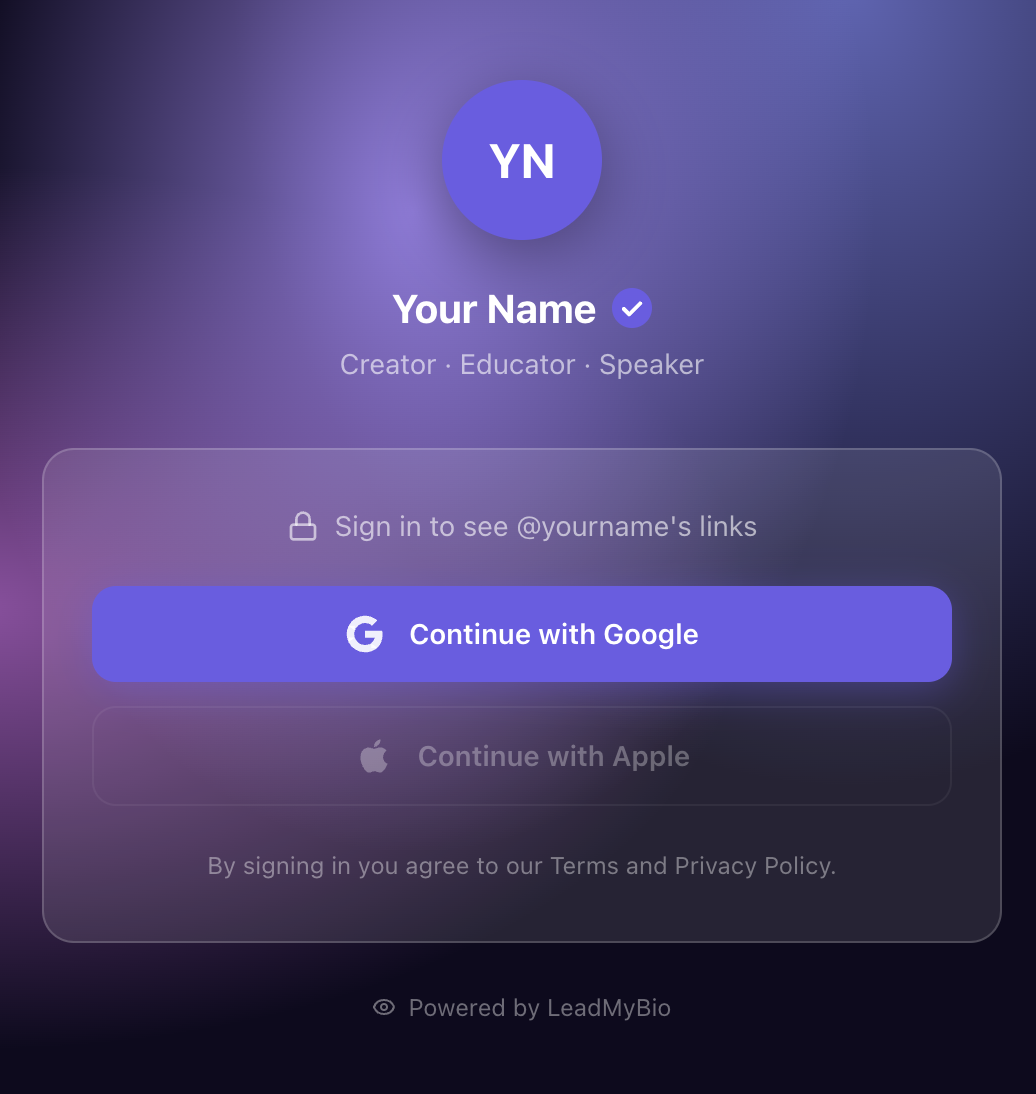
When you require a Google login to access your bio link, the psychology changes completely.
There's no "ask." There's no form. There's no newsletter pitch. There's a button that says "Continue with Google" — the same button that appears on thousands of apps and websites people use every day.
Visitors don't think "this creator wants my email." They think "I need to log in to see this." That's a completely different cognitive frame.
The resistance that normally kills email capture conversions disappears. The friction that produces fake addresses disappears. What's left is the natural behavior of someone who wanted to see your content badly enough to click your bio link — and is now one tap away from accessing it.
That one tap gives you their verified Google email address. Their real name. Without you ever asking.
The Quality Difference Is Enormous
Not all email addresses are equal. Here's what different capture methods actually produce:
Lead magnet form (free download):
- Conversion: 2-5% of visitors
- Email quality: Low — many are throwaway addresses
- Open rate: 10-15% (people forget they signed up)
- Identity: Unknown — you have no idea who this person is
Newsletter subscription form:
- Conversion: 1-3% of visitors
- Email quality: Medium — people who subscribed wanted the content
- Open rate: 25-35%
- Identity: Still unknown — just an email address
Google login via LeadMyBio:
- Conversion: 12-20% of visitors
- Email quality: Verified — this is the email tied to their Google account, the one they actually use
- Open rate: 35-45% (because the address is real and actively used)
- Identity: Name + verified email — you know exactly who visited
The verified email point deserves emphasis. When someone signs in with Google, Google has already confirmed that email address belongs to them and is active. It's not a fake. It's not a throwaway. It's the email they use for Gmail, Google Drive, YouTube — the one they check every single day.
LeadMyBio captures verified email addresses from every bio link visitor — one Google tap, no forms, no asking. Start building your list free →
What Happens When You Stop Asking
Here's a real scenario. Say you have 5,000 Instagram followers. Your posts get 2-3% engagement, which is healthy. On a good week, 200-300 people click your bio link.
With a form: 200 clicks × 2% conversion = 4 emails, some fake.
With Google login: 200 clicks × 15% conversion = 30 verified emails, all real.
That's 30 leads per week. 120 per month. 1,440 verified email addresses per year — from the same traffic, without ever asking anyone for anything.
Now think about what you can do with 1,440 people who definitely check their email, whose addresses you know are real, and who showed interest in your content by clicking through to your bio link. That's a warm list. That's an asset.
The Visitor Already Decided They Trust You
Here's the thing that makes bio link email capture uniquely effective: the visitor already made a trust decision before they clicked.
They saw your content. They engaged with it enough to tap through to your profile. They clicked your bio link. By the time they hit your LeadMyBio page, they've already decided they want to know more about you.
You're not cold-calling them. You're not interrupting them. They came to you.
In that context, a Google login doesn't feel like a demand. It feels like the next natural step to access what they came for. The completion rate for that step — logging in with Google — reflects that warmth.
Setup: 5 Minutes, No Technical Knowledge Required
You don't need a developer. You don't need to set up OAuth. You don't need to configure anything technical.
- Create your LeadMyBio account at leadmy.bio/login
- Add your links to your profile (same ones you have now)
- Copy your LeadMyBio profile URL
- Paste it as your bio link on Instagram, TikTok, YouTube, or wherever you're active
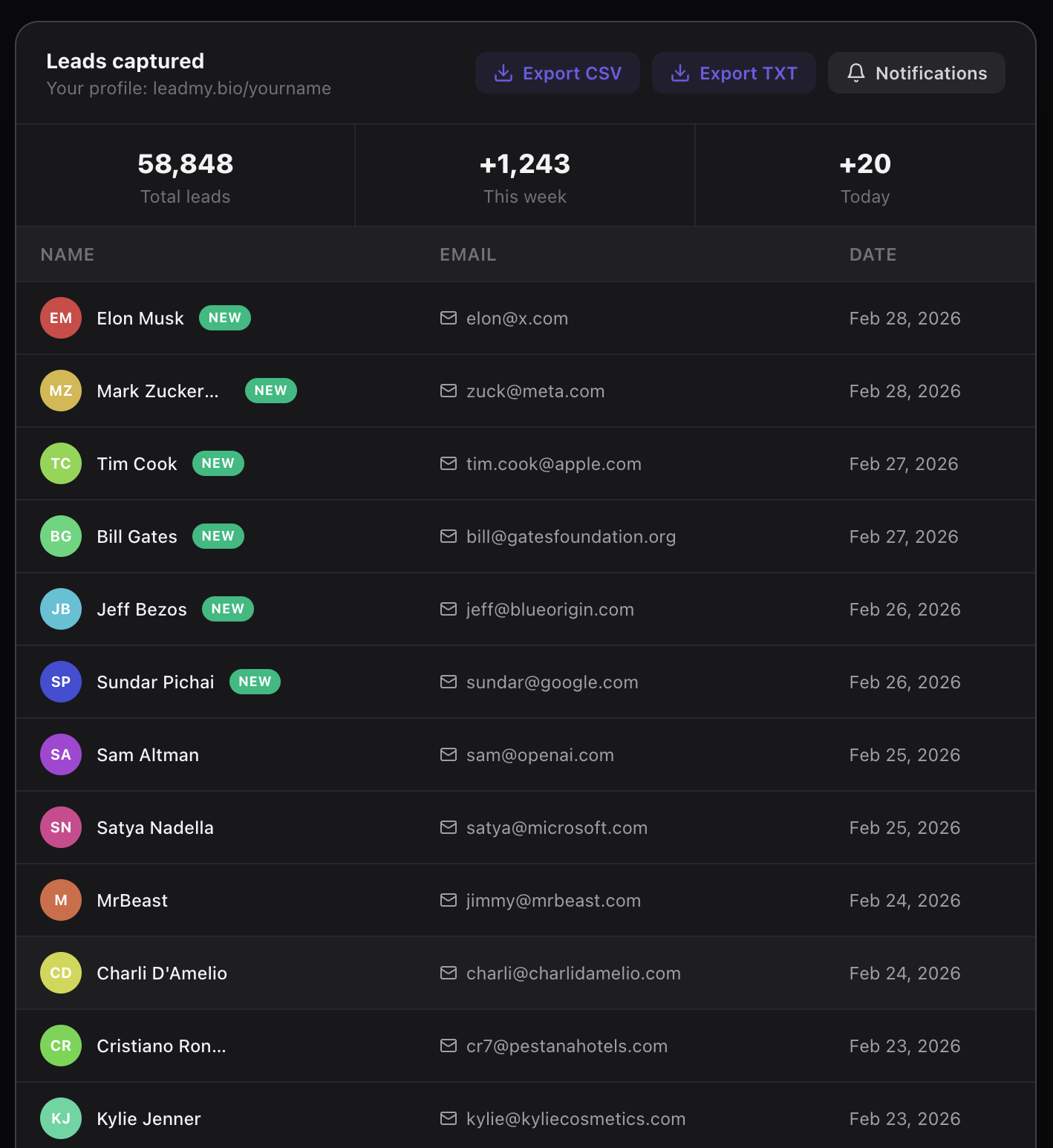
From that moment, every visitor gets a Google login prompt. Every login is a verified lead. Your dashboard fills up automatically.
You can export your list to CSV whenever you want. Import into ConvertKit, Mailchimp, or any email platform. Export and import takes about two minutes.
The free plan covers your first 1,000 leads at no cost, no credit card. After that, it's $9/month — less than a single email campaign management fee.
The List You Build Without Asking Is Worth More
Counter-intuitively, email addresses you never asked for are more valuable than ones you worked to get.
When someone fills out a form because you offered them a freebie, they've consented to that transaction. They might not particularly care about hearing from you again.
When someone Google-logs into your bio link to access your content, they've shown genuine intent. They wanted to see what you created. They're not there for a PDF — they're there for you.
That's a different quality of relationship, and it shows in open rates, click rates, and conversion rates when you eventually email them.
Stop asking. Start capturing. The followers who care about your work are already visiting your bio link. The only question is whether you're capturing them when they do.
Ready to start capturing real leads? Set up your LeadMyBio profile in 5 minutes. Free forever up to 1,000 leads. No credit card. Create your free profile →
Ready to start capturing real leads?
Set up your LeadMyBio profile in 5 minutes. Free forever up to 1,000 leads.
Create your free profile →