How Many Instagram Followers Do You Need to Make Money? (The Real Answer in 2026)
The search volume on this question is enormous. Millions of creators type it into Google every month, hoping for a clean number: 10,000 followers, 50,000 followers, 100,000 followers. Hit that number and the money starts.
The honest answer is that follower count is the wrong metric entirely — and every article giving you a specific number is, at best, incomplete, and at worst, actively misleading you about how creator income actually works.
This article gives you the real framework. It explains what follower count actually controls (less than you think), what actually predicts whether a creator earns real income (a different number), and the math that makes small audiences profitable when you approach them correctly.
The Platform-Specific Answers (For Context)
Before dismantling the premise, here is what platform-specific follower thresholds actually unlock — because these numbers are real, they are just often misapplied.
Instagram's own monetization programs require a minimum of 10,000 followers to access Creator Marketplace brand partnerships through Instagram's native tools. The Reels bonus program (where it exists) has varying thresholds by region, and ad revenue sharing via Instagram Subscriptions or Badges has its own requirements. If you want Instagram the company to pay you, you generally need 10,000+ followers and a qualifying account.
Brand deals start much lower. Nano-influencers (1,000–10,000 followers) regularly close paid partnerships with local businesses, niche DTC brands, and product companies that value audience specificity over raw reach. A creator with 3,000 highly engaged followers in a defined niche is genuinely more valuable to certain advertisers than a creator with 200,000 general lifestyle followers.
Affiliate income has no follower floor. It requires a click and a purchase, both of which can come from an audience of any size.
So the platform-specific answer is: it depends entirely on which revenue stream you are asking about. But here is the more important point — all of these answers assume your followers are your primary asset. They are not.
Why Follower Count Is a Bad Predictor of Income
The assumption embedded in the "how many followers do I need" question is that more followers means more money. The data does not support this cleanly.
Organic reach on Instagram currently sits around 5.2% for feed posts. That means a creator with 100,000 followers reaches approximately 5,200 people with an average post. A creator with 10,000 followers reaches about 520. The algorithm decides, and the algorithm's primary goal is keeping users on Instagram — not amplifying your sales message.
When you promote something, reach often drops further. Promotional content performs below average in the algorithm because users scroll past it, reducing the engagement signals that drive distribution. The followers you spent years accumulating are partly invisible to the content that actually matters to your business.
Followers are not buyers. A follower is someone who clicked a button at some point in the past, often while watching a viral video or browsing a hashtag. Many of them have never read your caption, never tapped your bio link, and could not tell you what you actually do. A large follower count represents an audience at arm's length — reachable only when the algorithm decides to show them your content, not when you have something important to say.
The result is that two creators with identical follower counts can have revenue differences of 10x or more based on factors entirely separate from follower count.
The Metric That Actually Predicts Creator Income
The metric that correlates with creator income is email list size combined with open rate and niche specificity.
An email subscriber is categorically different from a follower. They completed an active step — submitting or authorizing an email address — specifically to hear from you. They have demonstrated intent that a follow click does not.
Email delivers to 95%+ of recipients, versus 5% organic reach on Instagram. When you send an email to your list, it arrives. Open rates for creator newsletters average 30–45% with an engaged list. That means for every 1,000 email subscribers, 300–450 people actively open and read what you send.
Niche specificity multiplies the value of each subscriber. A fitness creator's email list of 500 subscribers who are specifically interested in postpartum strength training is worth dramatically more than 5,000 subscribers who vaguely follow a general wellness account. Specificity creates relevance. Relevance drives purchases.
Creator Income Scenarios: Who Actually Earns More?
Here is a direct comparison that illustrates the gap between follower-count thinking and list-size thinking.
| Metric | Creator A | Creator B |
|---|---|---|
| Instagram followers | 100,000 | 5,000 |
| Email list size | 0 | 2,000 |
| Instagram reach per post | ~5,200 | ~260 |
| People reached when promoting | ~5,200 | 2,000+ (email) + ~260 (IG) |
| Email open rate | — | 38% (760 people) |
| Monthly product revenue (5% conversion, $47 product) | $12,220 theoretical / $0 in practice (no list) | $1,786 consistently |
Creator A has 20x the followers. Creator B earns real, consistent income from their list while Creator A waits for the algorithm to show the right people the right post at the right time — which almost never produces consistent product revenue without a list to follow up with.
This is not a hypothetical. It is the standard outcome for creators who build email lists versus those who do not.
The Three Real Requirements to Monetize
None of these require a specific follower count.
1. A Niche-Specific Audience (Even 1,000 People)
The creator economy has a dangerous obsession with size. The more useful obsession is specificity. An audience of 1,000 people who share a specific problem, interest, or goal is a business-ready audience. A thousand postpartum moms looking for strength training programs. A thousand small restaurant owners trying to improve their online presence. A thousand beginner watercolor painters who want structured lessons.
Specificity is what allows you to build a product, write an email subject line, or make a pitch that resonates. A general audience of any size is hard to sell to because you do not know what they actually want.
2. A Way to Reach Them Directly (Email)
The word "directly" is doing heavy lifting here. Social media reach is intermediated — the algorithm decides when, whether, and to whom your content appears. Email is direct. You decide when to send. The recipient decides whether to open. The algorithm is not in the room.
Direct reach means you can make an offer when you have something to offer, not when the algorithm decides to surface your promotional post. It means your list of contacts belongs to you regardless of what any platform does tomorrow.
3. An Offer That Matches What They Want
Revenue requires a product or service. The follower count question often gets asked before this step is clear, which is why it is the wrong question. Once you know what you offer and to whom, the follower count becomes irrelevant — you need enough of the right people with a way to reach them.
The Real Income Math With Small Email Lists
Here is what honest monetization math looks like at small list sizes, using conservative assumptions: 35% open rate, 5% conversion on an email promotion, and a $49 digital product (course, guide, template, coaching session).
| List Size | Opens (35%) | Buyers (5% of opens) | Revenue per Launch |
|---|---|---|---|
| 200 leads | 70 | 3–4 | ~$175 |
| 500 leads | 175 | 8–9 | ~$425 |
| 1,000 leads | 350 | 17–18 | ~$860 |
| 2,000 leads | 700 | 35 | ~$1,715 |
| 5,000 leads | 1,750 | 87–88 | ~$4,300 |
These are single-launch numbers. Launch twice a month. Build a recurring product. Add an affiliate recommendation. The compounding is significant.
A creator with 2,000 email subscribers and a $49 product can generate $1,700 per launch. Launch twice a month: $3,400. That is real income, and it does not require 10,000 Instagram followers. It requires 2,000 people who trusted you enough to hand you their email address.
When Follower Count Does Matter
Follower count is genuinely important in specific contexts. To be honest about the framework, here is where the number actually matters.
Brand deals based on reach: Brands paying for awareness (impressions, reach, views) are buying access to your follower count. Here, the number matters directly. A brand sponsoring your content to reach 200,000 people is paying for that exposure. Small accounts negotiate lower rates or more niche-specific partnerships.
Platform ad revenue: Instagram, YouTube, and TikTok ad revenue programs pay based on views and reach. More followers generally means more views means more ad revenue. This is a real revenue stream where count matters.
Awareness campaigns: If your business model is building awareness for a cause, a movement, or a public identity, follower count is a legitimate proxy for impact.
The key distinction is that all three of these are reach-based revenue models. If your revenue model is selling a product, a service, a course, or a membership — reach-based thinking works against you. You need conversion-based thinking, and conversion comes from direct relationships, not algorithm-mediated exposure.
The Reframe: Stop Counting Followers, Start Counting Contacts
A contact is a person whose email address you hold. A person you can reach anytime, independent of any algorithm, on any platform, regardless of what changes at Meta or wherever next year.
Contacts compound in a way followers do not. A follower you gained three years ago may have muted your account, changed their interests, or rarely opens Instagram anymore. An email subscriber is re-qualified every time they open an email — their continued presence on your list signals continued interest.
The creators who build lasting income are almost universally the creators who prioritize building contact lists. The creators who chase follower counts often hit the thresholds they were aiming for and discover the income did not automatically follow.
How to Start Building Contacts From the Followers You Already Have
The followers you have right now — whether that is 800 or 80,000 — are the raw material for your email list. The mechanism is your bio link.
Every person who taps your Instagram bio link is demonstrating above-average interest in you. They went to your profile, read your bio, and tapped to learn more. That is a high-intent action. Most creators send that person to a generic Linktree with a list of links and collect nothing.
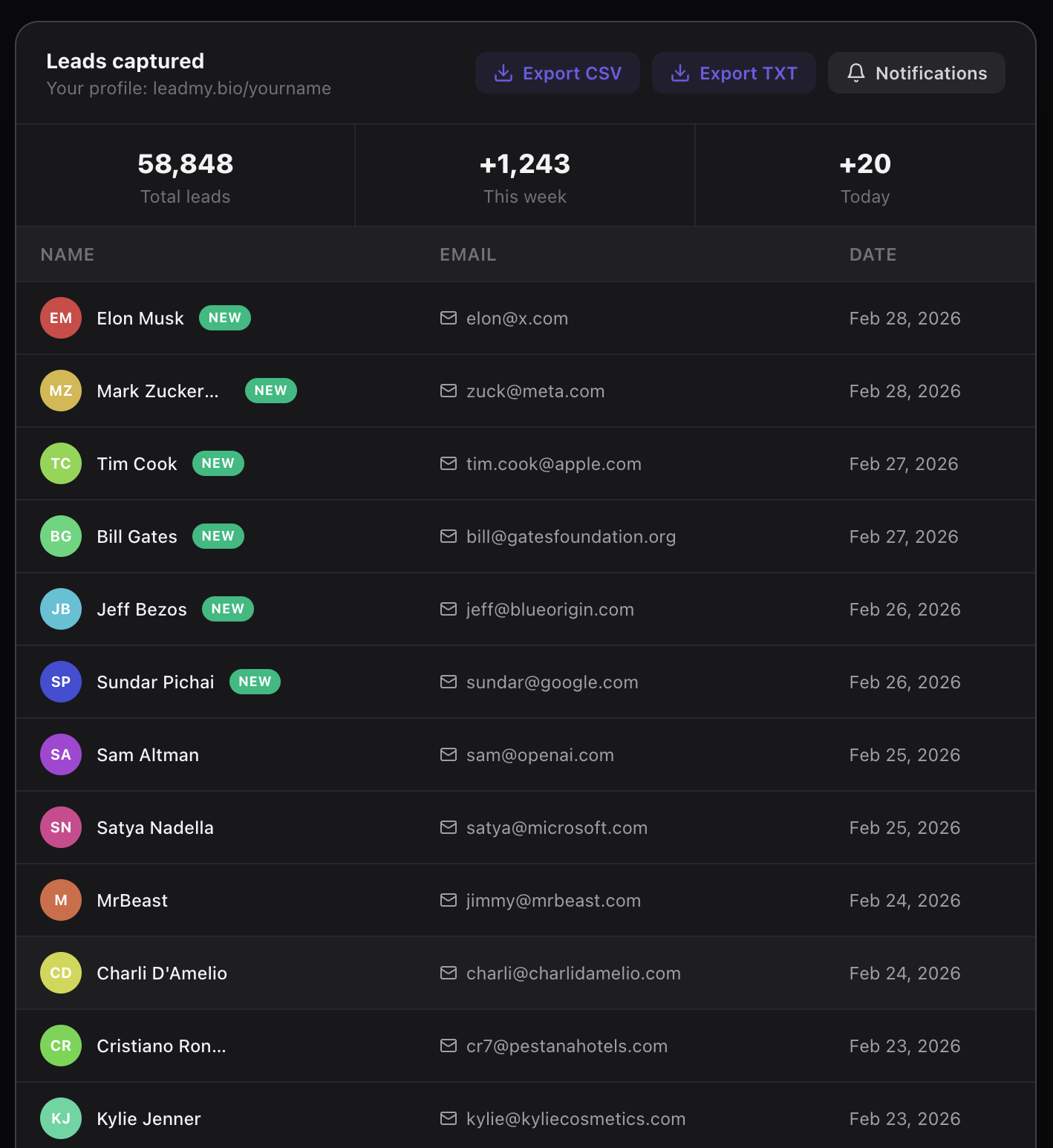
LeadMyBio converts that bio link visit into a verified email capture. When someone taps your bio link, they see a Google login prompt before accessing your links. One tap with their Google account — no form, no typing, no friction — and their verified email is added to your list. Conversion rates run 15–20% of bio link visitors versus 2–5% for traditional email forms.
Your bio link already gets traffic. The question is whether you are capturing anything from it.
If you have 5,000 followers and even 10% visit your bio link in a month — 500 people — and 15% of those convert to your email list, that is 75 new contacts per month. 900 per year. From the audience you already have, with no change to your content strategy.
Build that for two years: 1,800 contacts. Run the math from the table above. That is a business.
The answer to "how many followers do I need to make money on Instagram" is: fewer than you think, if you stop treating followers as your primary asset and start treating contacts as the number that actually matters.
Ready to stop renting your audience? Set up your LeadMyBio profile in 5 minutes. Free forever up to 1,000 leads. No credit card required. Create your free profile →
Ready to start capturing real leads?
Set up your LeadMyBio profile in 5 minutes. Free forever up to 1,000 leads.
Create your free profile →