How to Sell Digital Products to Your Email List (The Creator's Playbook)
You made a digital product. Maybe it's a course on your niche. Maybe it's a Notion template, an ebook, a coaching program. You announced it on Instagram. You pinned the link. You put it in your story.
Then you waited.
The results were somewhere between disappointing and humiliating.
Here is what likely happened: your post reached maybe 8–12% of your followers. Of those, somewhere between 0.1% and 0.3% bought something. On a 10,000-follower account, that means 10–25 people bought your product — if you were lucky, if the algorithm was generous, if your post got any traction at all.
There is a better channel. It converts 10 to 30 times better. You already know what it is.
The Gap Nobody Talks About Loudly Enough
Social media and email are not interchangeable distribution channels. They produce fundamentally different results when you're trying to sell something.
| Channel | Reach | Conversion Rate | Ownership | Cost |
|---|---|---|---|---|
| Instagram post (promotional) | 8–12% of followers | 0.1–0.3% | None — platform's rules | Free + algorithm risk |
| Instagram story promo | 4–8% of followers | 0.05–0.2% | None | Free + 24h disappearance |
| Email to your list | 35–45% open rate | 2–5% purchase rate | Full — you own the list | Flat monthly cost, no algorithm |
| Email (verified Google leads) | 38–48% open rate | 3–6% purchase rate | Full | Same flat cost, higher quality |
The math is stark. With 1,000 followers and a promotional post, you might reach 80–120 people and get 1–3 buyers. With 1,000 email subscribers and a well-written launch email, you reach 350–450 people and get 10–50 buyers from the same product.
That is not a marginal improvement. That is a different business.
Why Email Converts So Much Better
The answer is not magic. It is structure.
When you post on Instagram, your content enters a queue with every other post from every account your follower follows — plus paid posts, suggested content, Reels the algorithm wants to push. A promotional post is algorithmically disadvantaged before anyone sees it. The platform has no incentive to show your sales pitch to your audience; it has every incentive to show them content that keeps them scrolling and watching ads.
When you send an email, it lands in an inbox. There is no algorithm deciding whether this person is ready to see your promotion today. The email either gets opened or it doesn't — and that decision belongs to the reader, not to a recommendation engine.
There is a second factor: the act of giving you their email is itself a signal of intent. Someone who signs up for your list has made a decision. They took an action. That action took effort, even if small. It is qualitatively different from a passive follow-back.
Why Verified Email Leads Convert Even Better
Not all email subscribers are equal, and this is where the mechanics of list-building start to matter.
A cold lead — someone who filled out a form to get your free PDF — gave you whatever email they felt like typing. It might be a spam account. It might be an old inbox they check once a month. They wanted the freebie, not a relationship with you.
A verified email lead is different. This is someone who clicked your bio link and logged in with their real Google account — the one they actually use, the one that's tied to their identity. They didn't hand you an email to escape a popup. They authenticated. They saw your profile and decided to continue. That intent level, at the moment of capture, is reflected in how they behave as subscribers.
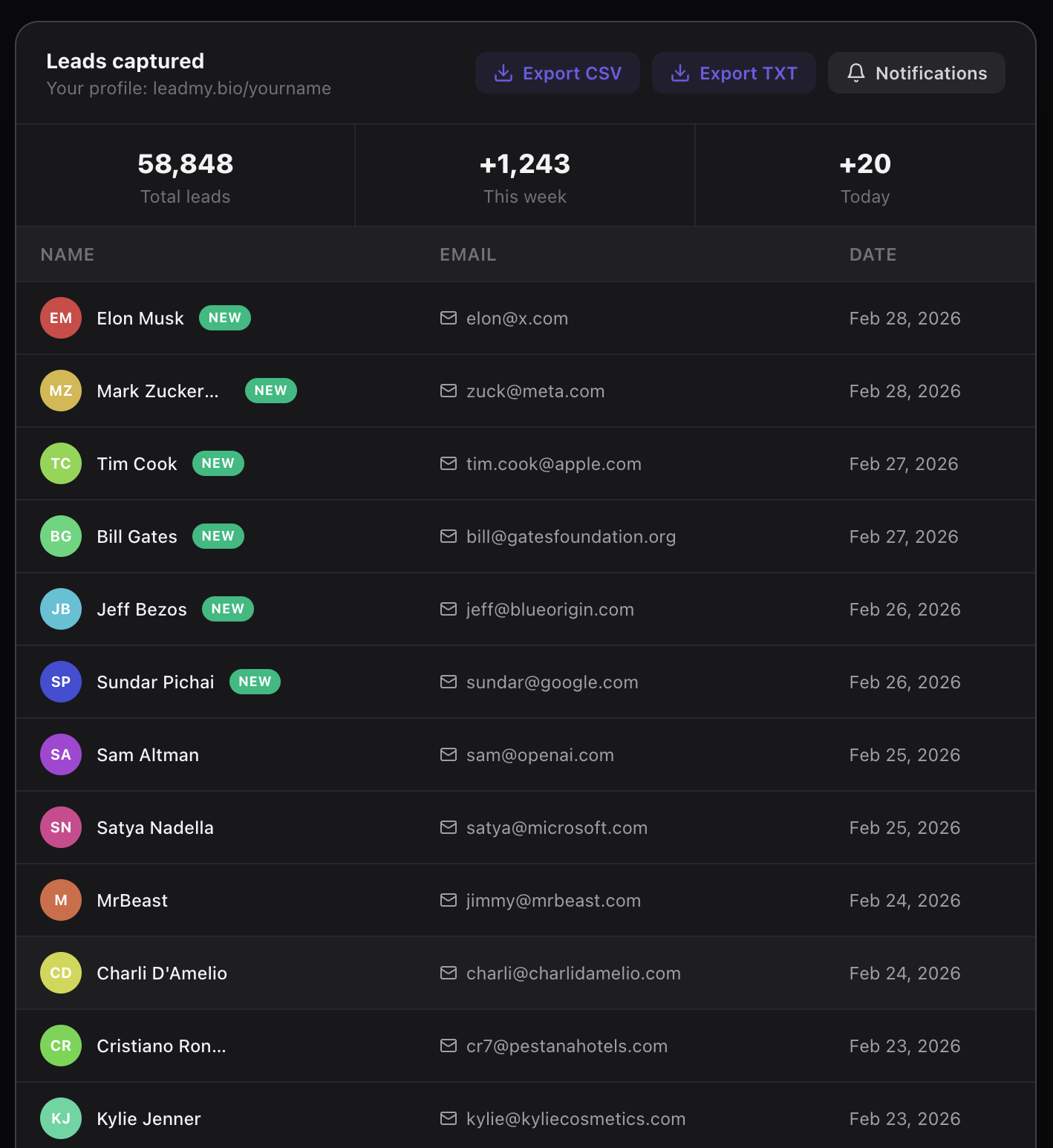
LeadMyBio captures exactly these leads. Every time someone taps your bio link, they see a one-tap Google login before accessing your content. Their real name and verified email go directly into your dashboard. No form, no fake addresses, no undeliverable bounce rates. Open rates on these lists run 38–48% because the contacts are real and the intent was genuine.
The 5 Digital Product Types That Work Best With Email
Not every product sells the same way over email. Here is how to match your product to the right email strategy.
| Product Type | Best Email Strategy | Typical Sequence Length | Price Range |
|---|---|---|---|
| Online courses / video training | Full launch sequence with cart open/close | 7–8 emails over 10–14 days | $97–$997 |
| Templates and tools | Single email + 1 follow-up | 1–2 emails | $9–$79 |
| Ebooks and guides | Single email or 2-email sequence | 1–2 emails | $7–$49 |
| Coaching and consulting | 3-email qualification sequence | 3 emails over 5 days | $500–$5,000+ |
| Memberships / subscriptions | Ongoing monthly email + renewal sequences | Recurring | $9–$99/month |
Online courses and video training are the highest-effort, highest-reward product category. They need a full launch sequence because the price point requires trust-building before the sale. You cannot ask someone to spend $297 on a course after one email. You need to prime them, show them the transformation is real, introduce the product, then close with urgency.
Templates and tools are ideal for single-email campaigns. The product is self-explanatory, the price is low enough that people decide quickly, and the benefit is immediately tangible. One email with a clear headline, one product screenshot, and a direct link is enough. These campaigns regularly convert at 4–8% because buyers don't need to be convinced — they need to be shown the thing exists.
Ebooks and guides behave similarly to templates in that the price point enables impulse purchases. A well-structured single email with a compelling hook and specific benefit statements ("learn the exact 5-step framework I used to go from 0 to 8,000 subscribers") converts without a long nurture sequence.
Coaching and consulting is a different sale. The price is high enough that email's job is qualification, not conversion. You send 2–3 emails that establish expertise and invite applications or discovery calls. The email doesn't close the sale — it gets the right person into a conversation where you can.
Memberships and subscriptions are where email becomes a retention engine. Your launch email acquires new members; your ongoing monthly emails are what keep them. Churn on memberships drops dramatically when creators send consistent, high-value member-only emails. Email is not just the acquisition channel — it is the product experience.
The Email Launch Sequence for Bigger Products
For anything priced above $97, you need a sequence. Here is the structure that consistently works.
Pre-launch: 7 days before cart opens (3 emails)
- Email 1 (Day 1): "Something is coming." Build anticipation without revealing the full product. Share the problem you're solving. Ask a question that makes them think. Subject line: "I've been working on something for you."
- Email 2 (Day 4): Share your origin story. Why you built this. What it cost you to learn what you're about to teach. This email is about credibility and connection, not the product.
- Email 3 (Day 7, cart opens tomorrow): Reveal the product. Name it, describe the core transformation, tell them what's coming tomorrow. Build anticipation. Do not put the link yet.
Cart open: Day 8 (1 email)
- Your full sales email. Clear headline, problem statement, product overview, what's included, price, guarantee, and a direct link. This email should be long enough to be complete — not padded, but thorough. Answer every obvious objection in the email itself.
During cart (Days 9–12): 2 emails
- Email 5 (Day 9): Social proof and FAQ. Real testimonials if you have them. Answers to the top 3–4 questions people ask. A reminder of the deadline.
- Email 6 (Day 12, 24 hours before close): Urgency without desperation. "Cart closes tomorrow." Remind them what they get, what they miss if they don't act, and give them one more direct link.
Cart close: Day 13 (1 email)
- Send it the morning of. "Last chance — closes tonight at midnight." No new selling. Just clarity, urgency, and a link. This is often the second-highest revenue email in the sequence after the cart open.
This sequence, on a list of 500–1,000 verified leads, will reliably generate 20–60 buyers for a $97–$297 product. At 1,000+ leads, you are looking at $5,000–$30,000 per launch, depending on your price point and how well you have warmed the list.
The Single-Email Sell for Lower-Ticket Products
For templates, ebooks, and lower-priced tools, a full launch sequence is unnecessary and actually works against you — too many emails for a $27 purchase feels absurd and trains your list to tune you out.
The single-email product launch structure:
- Subject line: Specific and self-explanatory. "The Instagram audit template I use before every content batch" beats "I made something new."
- Opening line: State the problem immediately. One sentence.
- The product: What it is, what it does, what they get. Three to five sentences maximum.
- One proof element: A result you got with it, or a specific outcome the buyer can expect.
- Price and link: State it plainly. "$19. Instant download. [Get it here]"
- Optional: A one-line guarantee. "Full refund if it's not useful."
That is the complete email. Fewer than 300 words. Sent once, followed by a 48-hour reminder email if you want to maximize revenue. This structure routinely converts at 4–8% on warm lists with verified leads.
The Math at 1,000 Leads
Here is a concrete calculation that removes any remaining abstraction.
You have 1,000 verified email leads captured via your LeadMyBio profile. You launch a $47 template pack.
- Emails delivered: ~980 (2% bounce rate on verified lists)
- Open rate: 41% (industry average for warm creator lists)
- Opens: 402
- Click rate: 22% of openers
- Clicks: 88
- Purchase conversion: 3% of email recipients (not just clickers)
- Buyers: ~29
- Revenue: 29 × $47 = $1,363 from one email
Send a 48-hour reminder email and add 30–40% to that number. Total: $1,900–$2,000 from a single $47 product to 1,000 leads.
Now compare that to posting on Instagram to 10,000 followers: average promotional post reaches 800–1,200 people, converts at 0.1–0.3%, and generates 1–4 buyers. Revenue: $47–$188.
Same product. 10x the social audience. One-tenth the revenue.
How to Build the List First
None of this works without the list. And building the list is simpler than most creators think, because the infrastructure for it already lives in the one place every creator already has traffic: their bio link.
Here is the sequence:
- Set up your LeadMyBio profile at
leadmy.bio/yourname. Add your links — the same links you already have in your bio. Takes 5 minutes. - Replace the URL in your Instagram (or TikTok, YouTube, LinkedIn) bio with your LeadMyBio link.
- Every visitor who taps your bio link sees a Google login screen. One tap on mobile. They log in and see your links normally. You get their verified name and email in your dashboard — automatically, without asking.
- Export your list as CSV and import it into whatever email tool you use: Mailchimp, ConvertKit, Beehiiv, Brevo, anything.
- Send the emails. Your list is ready before you ever write a campaign.
The capture happens passively. You do not need to run lead magnet campaigns. You do not need to beg people to subscribe. You need to direct traffic to your bio link the way you already do — and LeadMyBio converts that traffic into verified contacts at 15–20%, compared to 2–5% for traditional forms.
What to Do With a Small List (100–500 Leads)
The most common mistake creators make is waiting. "I'll think about email when I have a real list." They define "real" as 5,000 or 10,000 subscribers. They spend two more years building on platforms they don't own, then launch to a list that still does not exist.
The math works at small scale. Here is what 200 verified leads produces for a $47 product:
- Opens at 41%: 82 people
- 3% conversion: ~6 buyers
- Revenue: $282 from one email
That is not a business yet. But it is real revenue from a real audience, and it compounds. Every month you have LeadMyBio active, your list grows. The 200-lead list becomes 400, then 800, then 1,200. By the time you have 1,000 leads, the single-email launch math above applies and you are generating $1,000–$2,000 per product per campaign.
Small lists also teach you things large lists hide. At 200 leads, you can see exactly who opens, what subject lines work, what offers land. You optimize your emails at zero scale before you need them to work at full scale. When you hit 2,000 leads, you already know how to write the email that converts.
The only list that cannot earn revenue is the list you never built.
Start now. Build while you grow. Every day you wait is a bio link visitor you never capture again.
Ready to stop renting your audience? Set up your LeadMyBio profile in 5 minutes. Free forever up to 1,000 leads. No credit card required. Create your free profile →
Ready to start capturing real leads?
Set up your LeadMyBio profile in 5 minutes. Free forever up to 1,000 leads.
Create your free profile →