Paid Challenges vs. Online Courses: The $10K/Month Creator Monetization Shift That Defines 2026
The numbers are clear and most creators have not adjusted yet. Online course completion rates in 2026 have collapsed to under 5%. Paid challenges — short-form, interactive, time-bound versions of the same content — are hitting 70 to 80% completion. That is roughly 14 times more students who actually finish, refer friends, and buy the next thing.
The creators who switched their offer from "evergreen course" to "5 to 21-day paid challenge" in 2024 and 2025 are running $10K, $20K, and $40K-per-month businesses in 2026. They are not running ads. They are running a free lead magnet, a captured email list, and a recurring challenge launch every 6 to 8 weeks.
This is the shift that most creators have heard about and almost none have implemented. Here is what changed, why it works, and the exact infrastructure required.
Why the Course Model Broke
The online course model that defined the 2018 to 2023 creator economy assumed three things that are no longer true:
Assumption 1: People will complete a 40-hour course. They will not. The average course buyer in 2026 watches 12% of the content and never returns. Refund rates have climbed to 11 to 18% across major platforms.
Assumption 2: One launch generates one buying window. It used to. Open cart launches in 2019 closed at $50K to $250K for established creators. The same creators in 2026 are closing at $8K to $40K on identical funnels. The buyer fatigue is structural, not seasonal.
Assumption 3: The course is the asset. It is not. The list is the asset. The course is the conversion event for the list. Creators who optimized the course at the expense of the list ended up with a great asset they could not distribute to.
What replaced this model is not a new course platform. It is a new offer structure: the paid challenge.
What a Paid Challenge Actually Is
A paid challenge is a 5 to 21-day, daily-action, group-cohort offer at a $50 to $500 price point. The creator delivers one short lesson per day, one specific action per day, and operates a group chat or community where participants check in.
The format compresses the value of a 40-hour course into a 5 to 21-hour engagement window. Completion rates jump because:
- The time commitment is bounded and known
- The daily action is small and shippable
- The cohort effect creates accountability
- The end date forces completion or visible non-completion
- The group chat builds peer learning that reinforces the lessons
A creator who runs one challenge cohort per month at $147 to $297 with 80 to 200 participants is generating $12K to $59K per cohort. Net of refunds (which run 1 to 3% on challenges versus 11 to 18% on courses), that is a clean recurring monthly revenue.
The economics work because the challenge can be re-run with minor tweaks every cohort. The creator does not need to create new content every month — they re-run the same challenge with new participants.
The Infrastructure Required to Run This Model
The full stack is simpler than most creators expect. There are exactly four components:
1. A captured email list of the right size. A creator launching a $147 challenge to a 4,000-email list with 38% open rate and 8% conversion-to-purchase generates roughly $18K per launch. The list is the gating constraint. Without it, the model does not work.
2. A bio link capture mechanism. The list is built by capturing every bio link visitor's email at the moment of click. A Google Login gate converts at 18 to 22% of bio link visitors versus 0% for Linktree. For an active creator, this builds a list of 1,000 to 5,000 verified emails in the first 90 days.
3. The challenge offer itself. A 7 to 14-day cohort with daily lessons, daily actions, a group chat, and a clear outcome promise. The offer is the conversion mechanism for the list.
4. A simple email sequence and group platform. ConvertKit or Beehiiv for email. WhatsApp group, Discord, or a simple Circle community for the cohort. Total infrastructure cost: $40 to $80/month.
That is the entire stack. No course platform. No video hosting. No funnel software. The bottleneck on every creator running this model is the list size, not the tooling.
The Five Challenge Frameworks That Work in 2026
Based on the creator monetization data from the first quarter:
The 7-Day Income Sprint. "Make your first $1,000 freelancing in 7 days." Daily lessons + daily action. Common in finance, freelance, and reverse-hustle niches. Average price $97 to $197.
The 14-Day Habit Build. "14 days to a publishable newsletter habit." Common in writing, content, and creator-coaching niches. Average price $147 to $297.
The 21-Day Body or Health Challenge. "21 days to morning movement." Common in fitness and wellness. Average price $97 to $247.
The 5-Day Launch Sprint. "5 days to launch your offer." Common in coaching and consulting. Average price $197 to $497. Highest per-cohort revenue because of premium pricing.
The 10-Day Skill Sprint. "10 days to ChatGPT for [profession]." AI-skill-based challenges. Common in tech, marketing, and admin niches. Average price $97 to $247.
The pattern is consistent: short duration, daily action, group accountability, specific outcome. Every creator who has run this format three or more times has settled into a $10K to $40K monthly recurring revenue zone.
The Math of a Single Challenge Launch
For a creator with a 5,000-subscriber email list running a $147 challenge:
- Open rate on launch email: 42% = 2,100 opens
- Click rate on launch email: 14% = 294 clicks
- Conversion to purchase: 8% of clicks = 24 purchases
- Revenue from launch email: $3,528
Then add the launch sequence (7 to 10 emails over 5 to 7 days) which typically generates 3 to 4x the first email's revenue: total launch revenue $14,000 to $18,000.
Run that twice per quarter. $84K to $144K annual revenue from a list that is captured by a $0/month bio link gate and monetized through a $40/month email tool. Net margin north of 90%.
For comparison, the same creator running a $497 course launch to the same list typically closes at $9K to $14K because course buyer hesitation is structurally higher than challenge buyer hesitation. Same audience, same effort, 50 to 90% less revenue.
Why the List Is the Constraint
Every creator who switches to the challenge model hits the same bottleneck within the first two cohorts: list size.
The challenge model converts list to cash at a known rate (typically $2 to $5 per subscriber per launch when the offer fits the audience). A creator with a 1,000-subscriber list generating $2K to $5K per launch wants to scale. The only lever is list growth.
This is where most creators stall. They have the offer, they have run two cohorts, and they cannot grow the list fast enough to scale to $10K+ per launch.
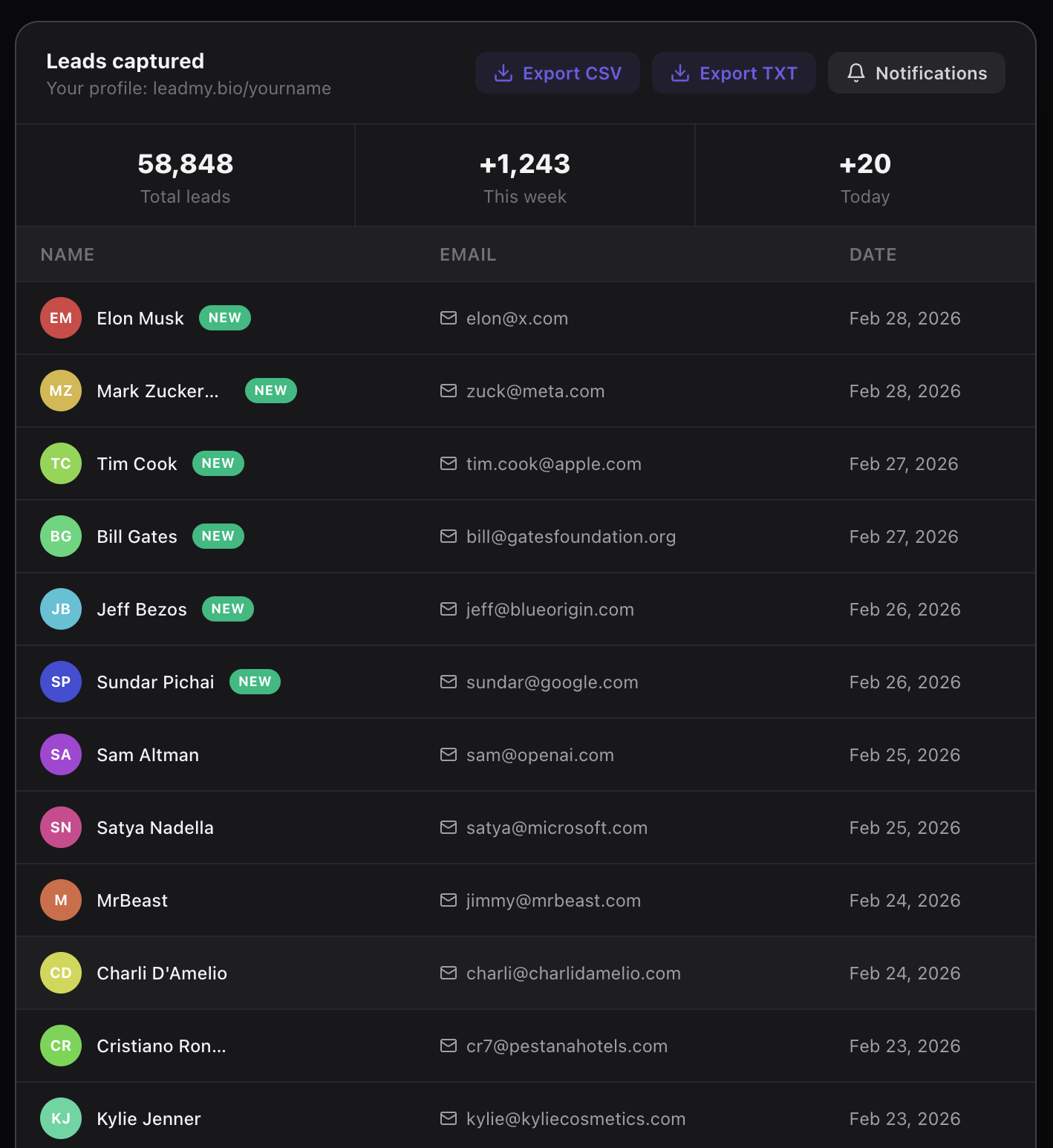
The fix is the bio link capture mechanism. Every viral Reel, every TikTok, every YouTube Short sends visitors to the bio. With a Google Login gate at the bio link, 18 to 22% of those visitors become verified email subscribers. With Linktree, 0%.
A creator with a moderately viral monthly content cadence (one Reel per week averaging 100K views) sends roughly 10,000 to 25,000 visitors to their bio per month. A capture mechanism converts that to 1,800 to 5,500 new emails per month. The list reaches 10K within 90 to 180 days. The challenge model scales to $30K+ per launch.
This is exactly the why creators lose leads when content goes viral problem. A viral moment is a list-building event only if the capture is in place. Without it, the moment passes and the asset never compounds.
The Setup, in Order
- Create a free account at leadmy.bio/login. 90 seconds.
- Build a one-page bio link with a clear lead magnet, your most relevant content, and one CTA.
- Choose a lead magnet that pre-qualifies for your future challenge offer. If you plan to run a "7-Day Income Sprint", the lead magnet should be "The Income Sprint Pre-Read PDF."
- Replace the bio link on every platform with the LeadMyBio URL.
- Post 8 to 12 pieces of content over the next 30 days designed to send traffic to the bio.
- Send a 3-email warm-up sequence to new subscribers introducing your voice.
- After 60 to 90 days of capture, run your first paid challenge cohort to the list at $97 to $147 to validate.
Free plan covers 1,000 leads. Most creators fill that quota in the first 60 days and upgrade to Premium at $9/month when the challenge revenue starts.
The challenge model needs a list. The list needs a capture mechanism. Set up the bio link gate at leadmy.bio/login. Free up to 1,000 leads. The first challenge cohort to a 4,000-subscriber list typically nets $12K to $18K. Build the list now.
What the Top Challenge Creators Are Doing Differently
Three specific behaviors separate the creators making $20K+/month from the ones stuck at $3K to $5K:
They run the same challenge multiple times. A challenge that worked at $147 in cohort 1 runs again at $197 in cohort 4 with 80% the same content and a refined sales sequence. Recurring revenue from a single asset.
They build a graduate community. Past participants get access to a paid alumni group at $19 to $39/month. This adds $2K to $8K/month in MRR on top of cohort launches.
They use the cohort to build the next list. Each cohort produces 5 to 15 testimonials, case studies, and referral subscribers. The list grows organically from the success of the offer.
The compounding effect is what makes this a sustainable business model rather than a one-launch event.
What Replaces the Course Model in 2026
The course model is not gone. Some creators still launch evergreen courses successfully — typically at $497 to $1,997 with a heavy onboarding component. But the dominant new offer structure is the paid challenge, and the secondary structure is the paid community subscription.
The order of operations is consistent across the highest-revenue creators in 2026:
- Capture verified emails at the bio link
- Send 30 to 60 days of pure-value content to warm the list
- Launch a paid challenge at $97 to $297
- Open a paid community subscription for graduates at $19 to $39/month
- Re-run the challenge every 6 to 8 weeks
- Add a higher-ticket offer at $1,500 to $5,000 for the top 3% of buyers
The model is repeatable. The bottleneck at every stage is list size. The list is built by the bio link gate.
FAQ
What if I do not have a course-worthy expertise? Challenges work for almost any niche where the creator has done something specific. "21 days of beginner running", "10 days of better cold emails", "7 days of writing one paragraph daily" — all have run successful cohorts in 2026.
Will paid challenges still work in 2027? The format will continue. The pricing might compress as more creators run them. Early adopters lock in pricing power and audience trust before the format saturates.
How big does my list need to be to run the first challenge? Minimum viable is 800 to 1,200 verified emails for a $97 to $147 first cohort. Below that, you can still run it as a beta with 8 to 15 participants at a lower price point to build testimonials.
What does LeadMyBio cost? Free up to 1,000 leads. Premium starts at $9/month. For a creator running paid challenges, the bio link gate pays for itself in the first cohort.
The course era is closing. The challenge era is open. The list is the asset that determines who runs $40K-month businesses and who keeps trying to launch a 40-hour video library.
Ready to start capturing real leads?
Set up your LeadMyBio profile in 5 minutes. Free forever up to 1,000 leads.
Create your free profile →