Podcasters: How to Build an Email List From Your Listeners in 2026
The average podcast listener spends around seven hours a week listening to shows. That is more time than they spend on Instagram, more than TikTok, often more than Netflix. They listen during commutes, workouts, and meals — returning to the same voices week after week with a level of trust that no other format can match.
And you have zero of their contact information.
Not because they have not been listening. Not because they do not care. Because Spotify, Apple Podcasts, and every other platform that hosts your show was designed to keep the listener relationship for themselves. You get download numbers. You get episode plays. You do not get a name or an email address for a single person who pressed play.
This article is about fixing that.
Why Podcast Platforms Are a Relationship Dead End
When someone follows your show on Spotify, they are not subscribing to you. They are adding your feed to their Spotify queue. Spotify controls when and whether they see your new episode in their feed, how prominently it is displayed, and which shows get surfaced in discovery.
Spotify's recommendation algorithm has shifted significantly over the past two years. In 2024 and early 2025, multiple podcasters reported 20–40% drops in listener counts after Spotify changed how their "Your Daily Podcasts" shelf was populated. Shows that had been growing steadily for years suddenly plateaued — not because the content changed, but because Spotify's surfaces changed.
Apple Podcasts has its own version of this problem. The platform gives hosts aggregate download data but no listener-level information. You cannot message your followers on Apple. You cannot alert them to a special episode or a course launch. You can only hope they open the app and find your show in their library.
This is the structural problem every podcaster faces: you are building an audience on land you do not own, and the landlord can change the rules at any time.
Why Podcast Listeners Make the Best Email Contacts
Here is what makes this situation particularly worth solving. Podcast listeners are not casual scrollers. They chose to subscribe to your show. They gave it time — real, uninterrupted time, not a three-second swipe. They listen to your voice, your thinking, your opinions, often for 30 to 60 minutes at a stretch.
By the time a regular listener has consumed ten episodes of your show, they know you better than most people who follow you on social media. They have heard your stories. They have absorbed your frameworks. They have formed an opinion about whether they trust you.
This makes them exceptional email subscribers. Research consistently shows that podcast-sourced email lists have higher open rates and click-through rates than lists built from cold social traffic. The trust is already there — it was built over hours of listening before they ever gave you their email.
The problem is not the quality of the relationship. The problem is that you have never had a way to formalize it.
The Show Notes Link Most Podcasters Waste
Every episode you publish has show notes. Whether you write three lines or three paragraphs, those show notes have one job in most podcast apps: to provide a link out.
Look at what most podcasters put in that link. A Linktree. A personal website homepage. Sometimes nothing at all.
That link is the single direct connection between someone who just finished listening to your episode and your ability to reach them again. A listener who opens your show notes and clicks your link is not a passive audience member. They are actively seeking more. They liked what they heard enough to take action.
Pointing that link to a page that asks for nothing — a page full of buttons that leads to more pages — is one of the most common and expensive mistakes in podcasting. You are letting the most interested fraction of your audience walk past without capturing anything.
The "Mention in the Episode" Strategy
You do not need to turn your show into an infomercial to capture emails. One natural mention per episode is enough — and it does not need to feel like an ad read.
The most effective approach is a contextual mention: at a moment that is relevant, not at the end after listeners have already stopped paying attention.
A few examples of how this sounds in practice:
- "If you want the full list of tools I just mentioned, everything is at leadmy.bio/yourname — I'll put it in the show notes too."
- "I send out a weekly breakdown on this exact topic. If you want it, just go to leadmy.bio/yourname."
- "All my links and resources are at leadmy.bio/yourname — that's where I keep everything in one place."
Notice that none of these are selling anything. They are pointing to a single place that organizes your content. Listeners hear this as a service, not a pitch. And because it is tied to something specific — the tools you mentioned, the breakdown you send — it gives them a reason to actually click.
The show notes link captures the people who actively look for more after an episode. The verbal mention captures the listeners who are driving and cannot look at their phone but will remember to search later.
Together, they cover most of the conversion surface area your show already has.
How to Set Up LeadMyBio as Your Podcast Link
LeadMyBio is built around one mechanic that fundamentally changes how link-in-bio pages work: visitors log in with Google before they see your links.
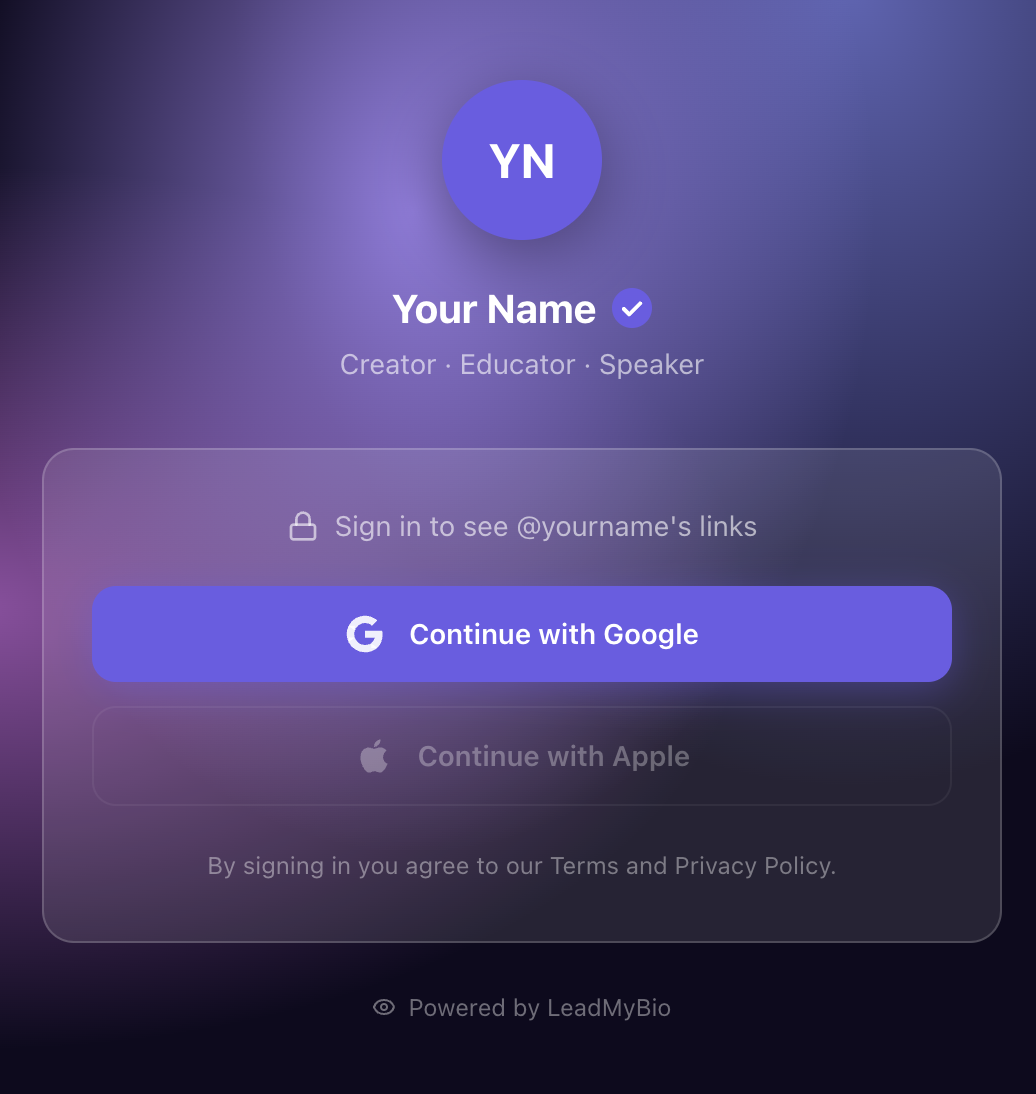
When a listener clicks your show notes link and lands on your LeadMyBio profile, they see a clean page with your photo, your name, and a "Continue with Google" button. One tap. Google autofills their verified name and email. Then your links appear — your episodes, your course, your newsletter, your community, whatever you want.
There is no form to fill out. No email address to type (and mistype). No reason to distrust the page. The Google login is the same button people use dozens of times per day. The friction is nearly zero.
The result is a 15–20% conversion rate on visitors, compared to 2–5% for traditional email forms. And the emails you capture are real, verified Google accounts — not burner addresses people create to grab a lead magnet and never check.
Setting It Up for Your Show
Step 1: Create your profile at leadmy.bio/login. Takes about five minutes. Add your relevant links — your episode archive, your website, your course, your community.
Step 2: Copy your LeadMyBio URL (leadmy.bio/yourname) and paste it into the website field of every podcast hosting platform you use: Spotify for Podcasters, Apple Podcasts Connect, your RSS feed settings.
Step 3: Add the same link to your episode show notes — either as a standard link or integrated naturally into your episode description.
Every platform, every episode, pointing to one place that captures every listener who clicks.
Podcast Followers vs. Email Subscribers: What You Actually Own
Podcasters tend to celebrate follower counts the same way YouTubers celebrate subscriber counts. The number feels like audience size. It is not.
| Metric | You own it? | Direct access? | Platform-dependent? | Contact info? |
|---|---|---|---|---|
| Spotify followers | No | No (algorithm) | Yes | No |
| Apple Podcasts followers | No | No (algorithm) | Yes | No |
| Download count | No | No | Yes | No |
| Email subscribers | Yes | Yes (send anytime) | No | Name + email |
Spotify can change its recommendation algorithm tomorrow. Apple can restructure its library view next quarter. Your download numbers can drop 40% without a single listener unsubscribing — simply because the platform stopped surfacing you in their feed.
Your email list does not change when Spotify updates its interface. It does not drop when Apple tests a new UI. It is a direct line between you and the people who wanted to hear from you — and it belongs to you.
The Passive Capture Loop
Here is something podcasters underestimate: old episodes keep working.
A podcast episode published in 2023 is still being discovered in 2026. Someone finds your show through a friend's recommendation, or a search result, or a Spotify suggestion. They binge six episodes in a weekend. They click the show notes link from episode 47, which you recorded two years ago.
If your show notes link from 2023 is still pointing to your LeadMyBio profile, that listener becomes a verified email contact in 2026 — months or years after you recorded the episode.
This is the passive capture loop. Your back catalog is not dead content. It is a distribution network that runs constantly, without any work on your part, as long as your links point somewhere that captures.
Most podcasters have 50, 100, 200 episodes of back catalog sending a small but steady stream of listeners to whatever link they put in their show notes. If that link is LeadMyBio, every one of those listeners becomes a contact. If that link is a generic website, they leave without a trace.
The Email + Podcast Flywheel
Once you start building an email list from your listeners, a compounding loop begins.
You publish a new episode. You send an email to your list about it — a short note with context, a key insight, a reason to listen. Your email subscribers, who are already loyal listeners, click through and stream the episode immediately. Early play numbers go up. Early engagement goes up. Platforms that weight recent engagement in their algorithm give your episode more surface area.
More people find the episode through platform recommendations. Some of them click your show notes link. Some of them become email subscribers. Your next episode reaches a slightly larger email list. Which drives slightly more early plays. Which drives slightly more recommendations.
This is not a theoretical loop. It is the mechanism that separates podcasters with 10,000 engaged subscribers from podcasters with 50,000 passive followers. The email list is what turns a platform audience into a direct relationship — and that direct relationship is what compounds over time.
Who This Matters Most For
If your podcast is your main platform — not a side project, not a repurposing channel, but the primary place you build your audience — then this is not optional infrastructure. It is the thing that makes the rest of your business work.
Course creators who podcast: Your show is your longest sales cycle. Listeners spend weeks building trust before they buy. The email list is what lets you have a conversation with them in between episodes — and what lets you close that cycle on launch day without depending on Spotify to notify them.
Coaches with shows: Your clients found you through your voice. They need multiple touchpoints before they reach out. Email gives you a way to stay present and provide value between episodes, without asking them to remember to check their podcast app.
Content creators who use podcasts as one channel: If you also post on YouTube, Instagram, or a newsletter, your podcast audience is probably your most loyal segment. Email gives you a way to cross-pollinate — bringing your podcast listeners to your other work, and your other audience to your best episodes.
In all three cases, the show is the trust-building engine. Email is the conversion layer. One without the other leaves most of the value on the table.
The Audience You Are Not Capturing Today
Every episode you publish, a small percentage of listeners click your show notes link. If your show gets 2,000 downloads per episode and even 3% of listeners visit that link, that is 60 people per episode seeking more contact with you. Across a 50-episode back catalog, that is thousands of high-intent visitors who came, looked around, and left without leaving a trace.
The setup is five minutes. The back catalog update — replacing old links with your LeadMyBio URL — takes an afternoon. The compounding effect of a growing list of verified listeners you can email directly takes months to build and years to pay out.
The best time to have started building your list was the first day your show went live. The second best time is today.
Ready to stop renting your audience? Set up your LeadMyBio profile in 5 minutes. Free forever up to 1,000 leads. No credit card required. Create your free profile →
Ready to start capturing real leads?
Set up your LeadMyBio profile in 5 minutes. Free forever up to 1,000 leads.
Create your free profile →