SXSW 2026 and the Creator Economy: What the Conference Reveals About Where Things Are Heading
SXSW wrapped its 2026 run on March 18 in Austin, and if you pay attention to where the creator economy conversations actually go — not the press releases, but the hallway debates, the packed afternoon panels, the after-hours dinners — one theme kept surfacing with unusual consistency.
Creators who are serious about building a sustainable business are done outsourcing their audiences to platforms.
That's not a new idea. But SXSW 2026 felt different: this year, the urgency was operational, not philosophical. The shift from "I should own my audience" to "I need to own my audience now" happened somewhere between TikTok's near-ban, Instagram's steady reach compression, and the arrival of AI-generated content at industrial scale. The conversation has matured. And what it's pointing toward — clearly, almost unanimously — is email.
Why SXSW 2026 Matters for Independent Creators
South by Southwest has always been a leading indicator, not a lagging one. The trends discussed in Austin in March tend to filter through the entire media and creator economy within six to twelve months. Brands adjust their budgets. Agencies shift their talking points. Platforms respond (or don't). And the creators who positioned themselves correctly in Q1 typically end up ahead by Q4.
This year, the conference moved its core programming window to mid-March precisely to give brands and creators a first-mover advantage — to get ahead of the content planning cycles that kick into gear in spring. The timing matters. What's being discussed at SXSW right now is what your competitors will be implementing in six months.
The dominant storyline at SXSW 2026 was not AI content creation, not short-form video formats, and not the metaverse. It was audience ownership — specifically, the risk of building an audience you don't actually control.
The Algorithm Dependency Problem Is Now a Business Risk
For years, algorithm dependency was treated as an annoyance. Reach is down, engagement is lower, the algorithm favors this format or that. Creators adapted. They chased trends, posted more, tested formats.
SXSW 2026 signaled that the industry has stopped treating this as a creative challenge and started treating it as a financial risk.
The language in panels shifted noticeably. Creators and their managers were talking about "concentration risk" — the same term a CFO uses when a company has too much revenue coming from a single client. If 80% of your reach lives on one platform, and that platform's algorithm changes, or regulators intervene, or the platform itself destabilizes, your business takes an 80% hit overnight.
TikTok's extended near-ban saga in the United States crystallized this for a lot of creators who had previously treated it as abstract. Millions of creators watched their primary distribution channel nearly disappear — not because they did anything wrong, but because of decisions made in Washington and Beijing that had nothing to do with their content. That's concentration risk. And it's not theoretical anymore.
Instagram's ongoing reach compression added a second data point. Organic reach on Instagram dropped another notable margin in late 2025, with creators reporting that posts were reaching a smaller percentage of their existing followers than ever. The platform's answer — push more Reels, pay for promotion — was not lost on anyone paying attention.
The consistent refrain at SXSW: social media is a discovery mechanism, not a distribution infrastructure.
The Signal from Brands: Email Lists Over Follower Counts
One of the more telling developments at SXSW 2026 was not what creators were saying about brands — it was what brands were saying about creators.
Several brand partnership panels surfaced a shift that has been building quietly for the past eighteen months: brand deals are increasingly being structured around email list size and engagement, not just follower counts or video views.
The logic is straightforward. A creator with 50,000 Instagram followers and 12,000 email subscribers represents a fundamentally different (and more predictable) media asset than one with 200,000 followers and no email list. Email reaches people. It doesn't get deprioritized by an algorithm. It doesn't disappear when a platform changes its feed ranking. It converts.
Brands have learned this through campaign data. Email-driven campaigns consistently outperform social-only ones on downstream metrics — conversion rates, purchase intent, repeat engagement. The 2025 data backs this up clearly: average email open rates for creator newsletters were hovering around 41%, while organic social reach on most platforms remained in the single digits as a percentage of total followers.
When brands started factoring email list size into creator vetting criteria, it changed the economics. Creators with smaller but owned audiences started commanding rates that previously required significantly larger follower counts. The metric that matters shifted.
AI Content Flooding and the Premium on Authentic Reach
There was a second force driving the owned-audience conversation at SXSW 2026: the sheer volume of AI-generated content now competing for attention on every platform.
By early 2026, the quantity of AI-assisted and fully AI-generated content across social platforms had scaled to a level that changed the signal-to-noise ratio for everyone. Platforms are struggling to surface authentic creator voices against a flood of synthetic content. Feeds are noisier. Attention is harder to hold.
The counterintuitive effect: authentic creator voices are actually becoming more valuable, not less. But they're becoming harder to find through algorithmic discovery alone.
This is why email functions as such a critical counterweight. When someone opts into your email list, they're making an explicit choice — not a passive scroll. That opt-in represents a level of intent that no algorithm-delivered impression can replicate. In an environment where synthetic content is everywhere, the direct relationship becomes the scarce resource.
Creators at SXSW who were building audiences with the most confidence were the ones who had systematically converted social followers into email subscribers over the past one to two years. They talked about social media as a top-of-funnel discovery tool — a way to reach new people — while treating email as the relationship layer where trust and commerce actually happen.
The IAB NewFronts Connection: Commerce, Video, and Email Converging
The IAB NewFronts on March 25 — running just days after SXSW wrapped — added another data point to the same picture. The NewFronts conversations around video commerce and AI-driven content monetization repeatedly returned to measurement: how do you actually know what worked?
Email is increasingly the answer. As creator-commerce integrations proliferate — shoppable video, affiliate links, brand collabs — email provides the trackable, persistent layer that lets creators and brands close the measurement loop. Click rates, open rates, conversion attribution: email offers data that social platforms control and often obscure.
The convergence happening in 2026 is video as discovery, email as conversion, and owned audience as the asset that makes both work. SXSW and NewFronts, one week apart, were both pointing at the same underlying architecture.
What the Data Looks Like Right Now
The SXSW conversations did not emerge from nowhere. The data behind them has been building.
In 2025, an estimated 28 billion emails were sent daily — a figure that continues to grow despite the prediction, repeated endlessly over the past decade, that email was dying. Paid newsletter revenue grew 138% year over year, with platforms like Substack and Beehiiv reporting creator payouts that rival what mid-tier influencers earn through brand deals. The creator newsletter space, in particular, has gone from interesting experiment to core monetization strategy for serious creators.
The email open rate benchmark for creator content — around 41% on average — compares against organic social reach that typically runs between 1.5% and 5% for most accounts. That gap has widened, not narrowed, as platform algorithms have tightened. The same audience member is dramatically more reachable via email than via the feed — and that's before accounting for the conversion rate difference once you have their attention.
How Creators Are Building Differently in 2026
The practical architecture being discussed at SXSW 2026 — and now being implemented by creators who absorbed those conversations — looks like this:
Owned distribution first. Email list growth is treated as the primary KPI, not a secondary metric. Follower counts are useful for discovery; email subscribers are the business.
Social as the top of funnel. Content on Instagram, TikTok, YouTube Shorts, and LinkedIn is optimized to drive people off-platform and into an owned channel — not to maximize native engagement metrics.
The bio link as conversion point. Because the bio link is the only consistently available path from social content to owned audiences on most platforms, it's being treated as premium real estate. The question isn't just "what link do I put here" — it's "how do I convert as many visitors as possible into email subscribers."
Frictionless capture. The shift away from long email signup forms toward one-tap options — Google login, for example — reflects the understanding that every additional step in the opt-in process costs conversions. The difference between a 2% form conversion rate and a 15–20% one-tap conversion rate, applied over a year of consistent traffic, is the difference between a small list and a real asset.
The SXSW Moment for Independent Creators Is Now
You didn't need to be in Austin to understand what SXSW 2026 revealed. The trends discussed at conferences like this are leading indicators. They compress time — showing you what serious players in your space are building toward before most people are paying attention.
The window for building an owned audience before it becomes the industry standard is still open. Not for much longer. As brand deals shift toward rewarding email list size, as AI content floods every platform, as algorithm volatility becomes a standard line-item risk in creator business plans — the creators who built their lists in 2026 will be ahead.
The entry point is simpler than most creators realize.
Start Where Your Audience Already Exists
Your bio link is the most underutilized asset in most creator strategies. Every piece of content you publish — every post, every video, every story — potentially drives someone to your profile. What happens when they get there?
If they land on a standard link-in-bio page and bounce, you've lost them. If they land on something that converts them into an email subscriber in a single tap — verified email, no form, no friction — you've added a permanent asset to your business.
That's the shift. Not a major strategic overhaul. One change at the conversion point where you're already getting traffic.
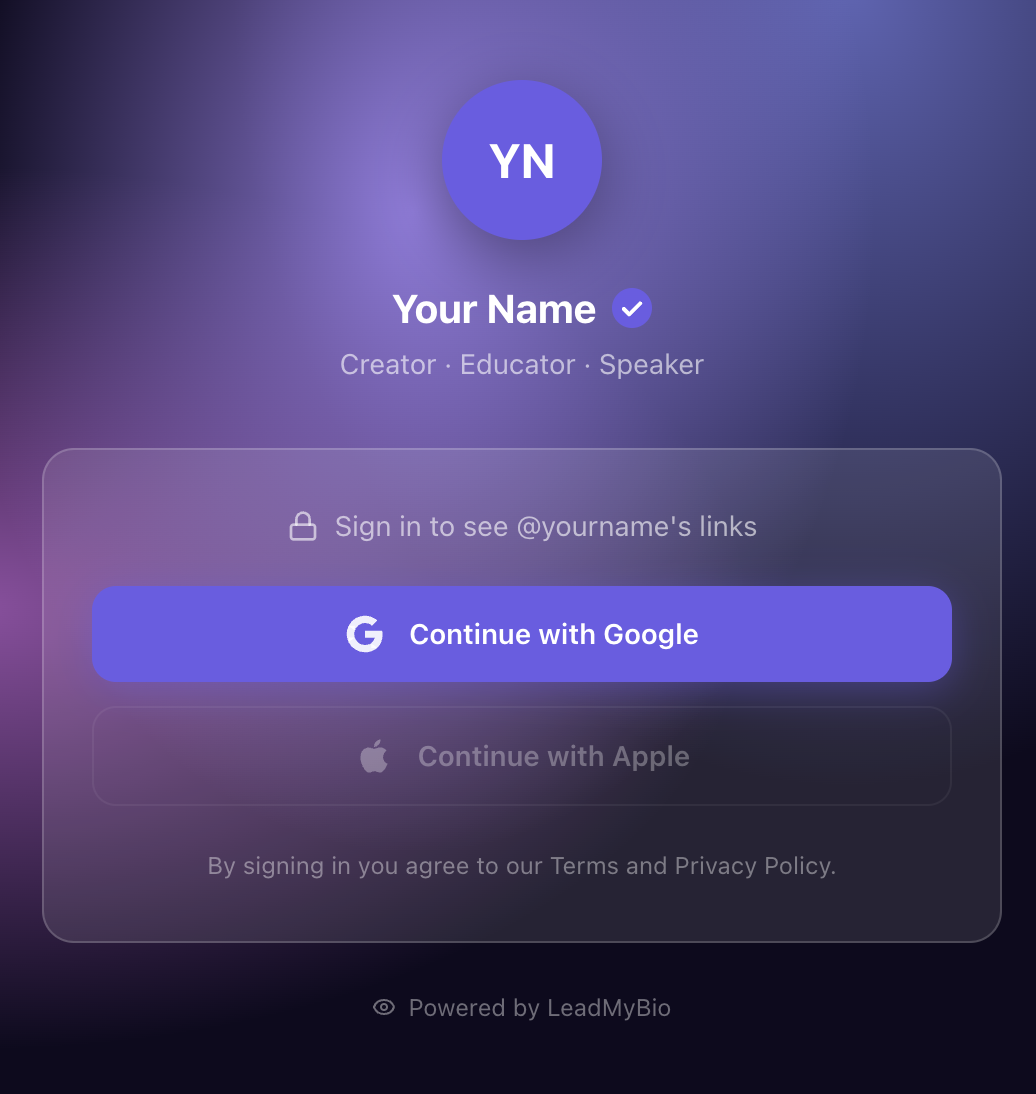
Tools like LeadMyBio are built specifically for this — a link-in-bio that captures verified emails via Google's one-tap login. Instead of asking followers to manually type their email into a form (2–5% conversion), visitors authenticate with Google and their verified email is captured automatically. Conversion rates run 15–20% in practice. The list you build is yours — not platform-dependent, not algorithm-dependent.
The creators having the most confident conversations at SXSW 2026 about their business three years from now were the ones who had already made this shift. The ones who hadn't were asking how to start.
Start with the bio link. It's the lowest-friction entry point into audience ownership that exists. And if SXSW 2026 revealed anything clearly, it's that the time to build is before the trend becomes obvious — not after.
Ready to stop renting your audience? Set up your LeadMyBio profile in 5 minutes. Free forever up to 1,000 leads. No credit card required. Create your free profile →
Ready to start capturing real leads?
Set up your LeadMyBio profile in 5 minutes. Free forever up to 1,000 leads.
Create your free profile →