Take It Down Act Goes Live May 19, 2026 — Why Every Creator Needs A Deepfake Defense Plan And An Email List Before The First Weaponized Takedown Notice Lands On Your Account
The federal Take It Down Act, signed into law on May 19, 2025, finishes its 12-month implementation grace period on May 19, 2026 — exactly 10 days from today. Starting that date, every covered US platform (Instagram, TikTok, YouTube, X, Reddit, OnlyFans, Twitch, Patreon, Whop, Passes, and any other public-facing user content site) is legally required to remove reported non-consensual intimate imagery (NCII) and harmful deepfakes within 48 hours of receiving a takedown notice.
For creators who have been targeted by AI-generated abuse — and across the 2025-2026 dataset, 1 in 7 female creators with 50K+ followers report at least one deepfake incident — this is the federal protection that legal advocates have spent two years pushing for. The law applies regardless of where the deepfake was hosted, regardless of who created it, and platforms face FTC enforcement penalties for non-compliance.
That is the upside. The downside is the structural vulnerability that arrives with the law: the same 48-hour mandatory removal mechanism can be weaponized against creators by bad-faith reporters — competitors, ex-partners, harassment campaigns, or trolls who file false notices to force platform-side takedowns of legitimate creator content. Platforms operating under FTC enforcement risk will trend toward over-removal in ambiguous cases.
For the creator with no audience capture infrastructure, a single weaponized takedown can wipe an account that took years to build. For the creator with a captured email and WhatsApp list, the same takedown is a 48-hour annoyance, not a business-ending event. The May 19 deadline is the forcing function. Here is the preparedness checklist, the legal context, and why the email list is the layer that survives the first weaponized notice.
What The Take It Down Act Actually Requires
The Tools to Address Known Exploitation by Immobilizing Technological Deepfakes on Websites and Networks Act (Take It Down Act) was signed by President Trump on May 19, 2025. Per the Skadden legal analysis of the Take It Down Act, three categories of platform obligations are now binding:
Notice and takedown obligation. Covered platforms must establish a notice-and-takedown system through which any user can report (a) non-consensual intimate imagery of any person, regardless of authenticity, and (b) any deepfake (AI-generated or digitally manipulated content) that depicts the reporter or another identifiable person in intimate or harmful contexts.
48-hour response window. Once a notice is received, the platform has 48 hours to remove the content — not 7 days, not 14 days, not the extended discretion windows that platforms have historically given themselves under DMCA-style processes.
Clear user notice requirement. Covered platforms must provide users with a "clear and conspicuous" notice about the platform's obligations under the Act, including how users can use the notice-and-removal system. This is being implemented as new policy disclosures across major platforms in early May 2026.
Safe harbor protection. Platforms that remove content in good faith based on a report — even if the content is later determined not to violate the Act — receive liability immunity. This is the structural reason platforms will trend toward over-removal.
Coverage is broad: any "covered platform" means public-facing websites and mobile applications that primarily allow user-generated content, host user-generated content visible to the public, or operate as marketplaces. Instagram, TikTok, YouTube, OnlyFans, Twitch, Reddit, X, Patreon, Whop, Passes, Substack, Beehiiv, Telegram, Discord — all covered.
Why The Law Helps Creators Who Are Real Victims
For creators who have been targeted by AI-generated abuse, the Take It Down Act is the most concrete federal protection that has shipped in three years of advocacy. The 2025-2026 deepfake landscape has exploded:
- AI face-swap tools accessible from any browser, generating photorealistic intimate imagery of any target with 5-10 source photos
- Telegram channels distributing creator-targeted deepfakes at industrial scale
- "Nudify" apps with millions of installs producing on-demand intimate manipulation of public photos
- AI voice cloning combined with video deepfake to create synthetic "leak" content
Pre-Take It Down Act, creators discovered such content circulating, reported it under platform-specific terms of service, and waited. Removal could take 7-30 days, sometimes longer. The content spread, was screen-recorded, was reposted across platforms, and by the time the original was removed the damage was done.
Post-Take It Down Act, the legal floor is 48 hours. The platform faces FTC enforcement risk for non-compliance, which means platforms staffing dedicated teams, automating triage, and erring toward removal. For creators who file legitimate notices about real deepfake content targeting them, the 48-hour window is a meaningful improvement.
The FTC has signaled that the first six months of enforcement (May 19 through November 19, 2026) will be active monitoring with public examples — meaning the first batch of platforms cited for non-compliance will face public enforcement actions. Platforms know this. Their internal policy is "remove on report; sort it out later."
The Weaponization Risk That Comes With Mandatory Removal
The structural problem with mandatory 48-hour removal is the same problem that existed with DMCA takedown abuse, but compressed: bad-faith reporters can use the takedown system as a weapon, and platforms operating under enforcement risk have asymmetric incentives to over-remove.
The 2026 weaponization patterns predicted by legal analysts:
Competitor takedowns. Creators in competitive niches (fitness, finance, lifestyle, beauty) where rival accounts have direct revenue impact get weaponized notices targeting their highest-performing content with claims of "manipulated imagery." Platform removes the content within 48 hours. Creator submits counter-notice. Reinstatement takes 7-21 days, often longer. By the time content returns, the algorithmic momentum is dead.
Ex-partner and harassment campaigns. Creators with public-facing personalities have at minimum one motivated antagonist. The Take It Down Act's broad definitions ("any deepfake that depicts intimate or harmful contexts") give wide interpretive room. False reports filed in volume — 5, 10, 50 per week — overwhelm both platform review and creator counter-notice capacity.
Coordinated mob attacks. Coordinated groups (Discord servers, 4chan threads, Telegram channels) targeting specific creators with mass-filed notices. Platforms operating under FTC enforcement pressure will not investigate before removing; they remove first, review later.
False positive AI detection. Platforms will deploy automated detection to triage reports. Early implementations of similar AI-assisted content moderation have 5-15% false positive rates on first-pass classification. For creators producing edge-case content (cosplay, costume, theatrical, satirical), the false positive rate can compound.
The legal protection for the creator is the counter-notice process: file a counter-notice asserting the content is legitimate, the platform must reinstate within 10-14 days. But the 10-14 day gap is exactly the window in which an algorithmic creator account loses everything: the velocity stalls, the audience disengages, the algorithm classifies the account as low-priority, and even after reinstatement the recovery is months.
Why The Email List Is The Layer That Survives Weaponized Takedowns
Here is the structural point that no platform Help Center article will tell you: a takedown wave can kill your platform-resident audience overnight, regardless of whether the underlying notices are legitimate. The audience that you have captured in your own database, by email and WhatsApp, is the only layer that survives.
The pattern across 2025-2026 case studies is consistent:
-
Creator with 200K Instagram followers, no email list, hit by coordinated 30-notice attack. Account suspended pending review. Reinstated 21 days later. Lost 60% of engagement velocity. Took 8 months to recover prior reach. Estimated revenue loss: $40K-$80K.
-
Creator with 500K TikTok followers, captured email list of 35K, hit by similar coordinated attack. Account suspended for 18 days. Used email list to direct audience to backup Instagram + YouTube. Maintained 70% of revenue during outage. Reinstated TikTok in 18 days, full recovery in 6 weeks. Estimated revenue loss: $8K-$15K.
The email and WhatsApp captured list provided five things during the takedown event:
- Communication with audience independent of platform: when the platform-resident audience couldn't see your content, the email subscribers could.
- Ability to direct traffic to alternative platforms: backup Instagram, YouTube, blog, alternate TikTok account.
- Counter-narrative distribution: explanation of the takedown attack to your audience, preventing reputation damage.
- Continued monetization during outage: email-based product launches, affiliate links, sponsorship traffic continued working.
- Algorithmic re-warming after reinstatement: directed traffic back from email to the reinstated account, re-establishing engagement velocity.
None of this is theoretical. The 2025-2026 creator economy already shipped enough takedown abuse cases that the email list ROI under takedown scenario is now a documented metric: creators with email lists of 5%+ of follower count maintain 60-80% of revenue during takedown outages; creators without lists lose 80-100%.
The May 19, 2026 Creator Preparedness Checklist
For creators preparing for the post-May-19 environment, the checklist below is the minimum viable defense:
1. Audit your current deepfake exposure. Search your name + "deepfake" on Google, Bing, and the major social platforms. Search reverse-image of your most public photos using TinEye and Yandex (more permissive than Google). Identify any existing deepfake or manipulated content already circulating; queue takedown notices for May 19.
2. Set up a takedown notice template. Per Latham & Watkins' analysis of Take It Down Act compliance, a notice must identify the content, the platform location, your identification as the depicted person, and an attestation of non-consent. Pre-draft this template now so you can submit within minutes when content is identified.
3. Set up an audience capture layer that survives platform-side takedowns. Use LeadMyBio as the bio link layer that captures email + WhatsApp from your existing follower flow. Free up to 1,000 leads. This is the single most important step — without captured audience, a takedown is a business-ending event.
4. Build a takedown-event communication plan. When (not if) a platform-side suspension hits, you need a pre-written email sequence that goes out within 24 hours: explanation of the situation, where to find you on backup platforms, expected return timeline. The email list converts a panic into a managed event.
5. Diversify across at least three primary platforms + your email list. Instagram + TikTok + YouTube + email/WhatsApp = portfolio diversification. A weaponized takedown wave hitting one platform doesn't kill the others, and the email list keeps the audience flowing across platforms.
6. Document your content pipeline. Keep raw camera files, behind-the-scenes footage, and creation timestamps for any content that could potentially be reported. In a counter-notice dispute, the burden of proof shifts to whoever has documentation. Creators with dated source files reinstate faster.
7. Pre-register with platform creator support tiers where available. Instagram Verified, TikTok Creator Marketplace, YouTube Partner Program — these tiers come with prioritized review queues that can compress reinstatement from 14 days to 3-5 days.
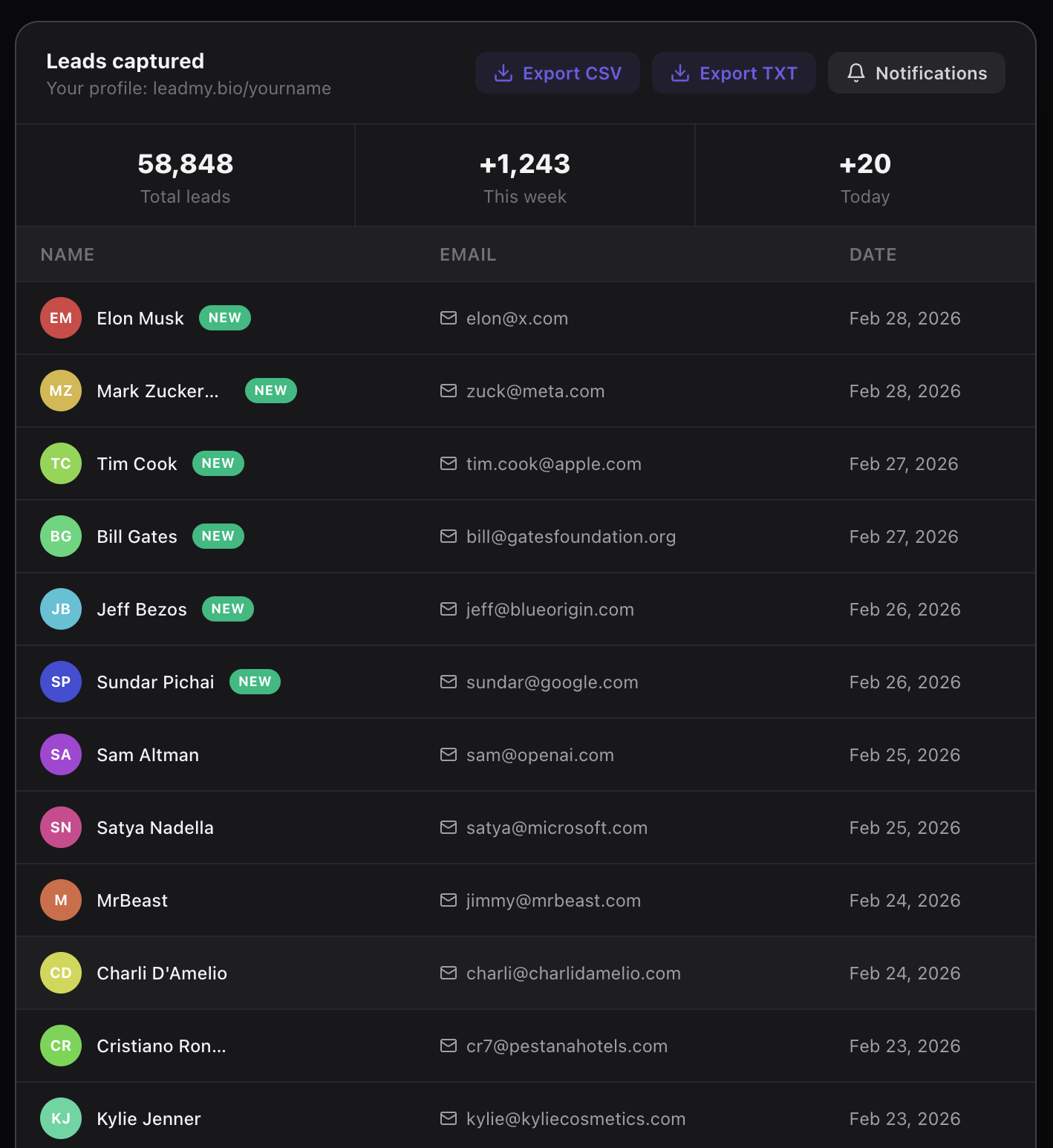
Don't wait for the first weaponized notice to arrive on your account. Set up email and WhatsApp capture today at leadmy.bio/login. Free up to 1,000 leads. The Take It Down Act enforcement window opens May 19. Your audience capture infrastructure should be live by May 18.
What Platforms Are Building For May 19
The major platforms have been quietly staffing up Take It Down Act compliance teams since Q4 2025. Visible signals across early May 2026:
Meta (Instagram, Facebook): New "intimate content review" reporting flow rolling out across IG and FB. Increased automated triage. Per Meta's Account Integrity update from late April, the same enforcement infrastructure handling general policy violations is being extended to Take It Down Act cases.
TikTok: Updated Trust & Safety reporting flow with Take It Down Act-specific category. Dedicated 24/7 review staffing in Singapore + Dublin + LA hubs. Per TikTok's May 2026 updates roundup, implementation is slated for May 12, 2026, ahead of the federal deadline.
YouTube: Expanded the existing privacy violation reporting flow to include AI-generated and manipulated content categories. Manual review headcount reportedly doubled.
X (Twitter): Trust & Safety team expanded after years of cuts. Take It Down Act-specific reporting flow staged for May 15.
OnlyFans, Whop, Passes, Patreon: Smaller platforms relying on increased automated detection plus human review. OnlyFans particularly exposed because of the platform's content type; reportedly contracting third-party deepfake detection vendors to triage.
The infrastructure is being built around the assumption that report volume will spike on Day 1 (May 19) and remain elevated for 60-90 days as the public learns about the new mechanism. Platforms expect a 3-5x increase in NCII/deepfake-related reports during the first 90 days post-enforcement.
The Asymmetry: Bad-Faith Cost Vs. Creator Recovery Cost
The structural problem with mandatory 48-hour removal is asymmetry of cost. For a bad-faith reporter, the cost of filing a false notice is approximately zero — minutes of time, no legal liability if filed in apparent good faith, no platform-side cost. For the creator on the receiving end, the cost of a single false notice can include:
- 14-21 days of account suspension during review and counter-notice
- 60-80% loss of algorithmic engagement velocity
- 6-12 month recovery time for full audience reach
- $5K-$80K of estimated revenue loss during the outage and recovery
The mathematical asymmetry — zero-cost weaponization, multi-thousand-dollar creator damage — guarantees abuse. Legal scholars analyzing similar prior systems (DMCA takedowns, copyright strikes on YouTube) document the same pattern: the cost asymmetry incentivizes weaponization, weaponization scales, platforms struggle to triage.
The Take It Down Act's safe harbor provision protects platforms that remove in good faith. It does not protect creators who suffer collateral damage from over-removal. The remedy for the creator is the counter-notice + civil suit against the bad-faith reporter — but civil suits cost $5K-$50K and take 12-24 months. The practical recovery happens faster through algorithmic warm-up after reinstatement, which in turn requires the captured email list to direct traffic.
What Creators Should Do This Week (May 9-18, 2026)
The 10-day window before enforcement begins is the planning window. Concrete actions:
Days 1-2 (May 9-10): Set up LeadMyBio bio link with email + WhatsApp capture. Configure your existing CTA flow. Free up to 1,000 leads, no credit card required.
Days 3-5 (May 11-13): Drive your existing social audience to the new bio link. A pinned story on IG, a pinned video on TikTok, a community post on YouTube directing the most engaged 5-10% of your audience to capture. Goal: 500-2,000 captured contacts.
Days 6-7 (May 14-15): Pre-write your takedown event email sequence. Three messages: (a) outage alert, (b) where to find me on backup platforms, (c) reinstatement notification. Draft and save in your email tool.
Days 8-9 (May 16-17): Audit your existing content for any clips that could be misreported. Document creation dates, save raw files, organize counter-notice evidence in a folder you can access in 5 minutes.
Day 10 (May 18): Final check. Email capture working. WhatsApp opt-in working. Backup platforms identified. Counter-notice templates saved. Email sequence drafted. You're ready.
The creators who treat May 19 as a routine enforcement date are exposed. The creators who treat it as a forcing function for audience ownership infrastructure are protected. The window is open for 10 more days.
Read also: Instagram ends end-to-end encryption — why creators must own their audience, Account Integrity ban wave hitting creators with no explanation, and Repost penalty April 2026 — discovery dead, email list essential.
FAQ
Does the Take It Down Act apply to platforms outside the US? The law binds platforms operating in the US or providing services to US users. In practice, every major social platform serves US users and is therefore covered. Non-US-based platforms with US users (e.g., TikTok via ByteDance) are also covered through their US-facing operations.
What counts as a "deepfake" under the Act? The Act covers AI-generated or digitally manipulated content depicting an identifiable person in intimate contexts, or in harmful contexts where the manipulation is intended to deceive. The "harmful contexts" definition is broad and is expected to be litigated in early enforcement actions.
Can I file a Take It Down Act notice for content I find about myself? Yes. The Act's reporting mechanism is open to the depicted person (or their representative for minors). You don't need a lawyer to file the initial notice; a self-prepared notice meeting the statutory requirements is sufficient.
What if a platform doesn't comply within 48 hours? The FTC has enforcement authority. You can report non-compliance to the FTC. Civil remedies are also available against the platform under the Act's enforcement provisions.
How do I file a counter-notice if I'm wrongfully reported? Each platform's counter-notice process is being implemented separately. Most are using a form-based system: identify the content, attest to authenticity, provide identifying information. Counter-notice triggers a reinstatement window (typically 10-14 days).
Will the Take It Down Act affect my ability to post legitimate content? For most creators, no. The law targets non-consensual intimate imagery and harmful deepfakes specifically. Routine creator content is not affected. The risk is collateral damage from over-removal in ambiguous cases.
Is the email list really necessary, or can I just rely on platform reinstatement? The email list is what bridges the 14-21 day reinstatement gap without losing your audience. Without it, reinstatement preserves the account but not the engagement velocity. With it, you retain audience flow during outage and re-warm faster after reinstatement.
The Take It Down Act is the most significant federal creator protection law in a decade. It's also the most significant new exposure vector for weaponized takedown abuse since the DMCA. The creators who survive May 19 with their businesses intact are the ones who built the captured audience layer first. The platform decision is reversible. The audience asset is permanent. Configure capture today, before the first weaponized notice arrives in your inbox.
Sources:
- Take It Down Act Requires Online Platforms To Remove Unauthorized Intimate Images and Deepfakes — Skadden
- TAKE IT DOWN Act Targets Deepfakes: Are Online Platforms Caught in the Crosshairs? — Morgan Lewis
- President Trump Signs Take It Down Act Into Law — Latham & Watkins
- TAKE IT DOWN Act Becomes Law — Orrick
- TAKE IT DOWN Act — Wikipedia
- Tools to Address Known Exploitation by Immobilizing Technological Deepfakes Act — FTC
- TikTok updates May 2026 — SocialBee
- Complete Guide to U.S. Deepfake Laws — ComplianceHub
Ready to start capturing real leads?
Set up your LeadMyBio profile in 5 minutes. Free forever up to 1,000 leads.
Create your free profile →