Spotify Personal Podcasts AI Goes Live May 7, 2026 — And The Day Audio Becomes Infinite Is The Day Real Podcasters Need An Email List To Survive The Algorithm Reset
On May 7, 2026, Spotify quietly launched Personal Podcasts — a feature that generates a custom AI podcast for any user from any text input: their calendar, their notes, their travel itinerary, the news headlines they care about. One day later, on May 8, 2026, Spotify shipped a command-line tool that lets AI agents like Claude Code, OpenClaw, and Anthropic's MCP-compatible tools publish podcasts directly to the Spotify platform.
The two announcements are not coincidental. Spotify just built and released the infrastructure for infinite AI-generated audio supply. Any user can now have a personalized podcast. Any developer can now publish AI-generated podcasts to Spotify at scale. The supply curve for podcast content just went from "thousands of hours per day from human creators" to "infinite hours per day from AI agents."
For the human podcaster who has spent 3-7 years building an audience through Spotify discovery — the New & Noteworthy charts, the Spotify-curated playlists, the search algorithm that surfaced niche shows — the math just changed. The algorithm that used to surface a thoughtful 30-minute interview to 10,000 new listeners per week now has to choose between that interview and 10,000 AI-generated competitor episodes pushed by automated upload tools. The discovery layer doesn't disappear; it dilutes 1000x.
The structural truth that lands on every audio creator on May 9, 2026: Spotify-resident audience that depended on the platform's discovery algorithm is now exposed to dilution. The audio creators who survive the dilution are the ones who own the listener relationship — by email, by WhatsApp, by direct subscription independent of the platform's discovery layer. Here is what changed, what it means, and the playbook for podcasters before the AI flood saturates the platform.
What Spotify Actually Shipped On May 7-8
The two launches function as one strategy. Per Spotify's newsroom announcement of Personal Podcasts on May 7 and the TechBriefly coverage of the May 8 CLI tool, here's what's now live:
Personal Podcasts (consumer feature, May 7). Any Spotify user can now request a custom podcast generated on-demand. Use cases shown in launch demos:
- "Summarize my class notes from this week into a 20-minute podcast I can listen to on my commute"
- "Generate a daily briefing of the news topics I care about based on my feed"
- "Turn my travel itinerary into a podcast about the destinations and what to see"
- "Read my reading list into discussion-format audio between two AI hosts"
The audio quality is the same multi-voice TTS quality Spotify shipped in late 2025. The episodes are private to the user who generated them by default, but Spotify's launch announcement explicitly notes that public-share options are being rolled out for "creators who want to publish their AI-generated content."
Spotify Developer CLI for AI Agents (developer feature, May 8). A command-line tool that integrates with AI agent systems (Claude Code, OpenClaw, MCP-compatible agents) and lets them programmatically:
- Generate podcast episodes from any text input
- Upload to Spotify under any Spotify-connected account
- Publish public, shareable, discoverable podcast episodes
The CLI was launched as developer-facing tooling, but the implications extend far beyond developer use cases. Any AI agent system can now operate as a podcast publisher at machine scale. The barrier to publishing a Spotify-discoverable podcast just dropped from "produce, edit, distribute" to "type a prompt."
Why This Is The Moment Audio Supply Goes Infinite
The text-content supply went infinite in late 2023 when GPT-4 and Claude 2 made AI-generated articles indistinguishable from human-written ones at the read-and-skim level. The image supply went infinite in mid-2023 when Stable Diffusion and Midjourney 5 democratized photorealistic image generation. The video supply went infinite in early 2026 when Sora 2 and Runway Gen-4 reached production-quality short-form output.
Audio was the holdout. Even through 2025, AI-generated podcasts were detectable: voices were close-but-not-quite, conversational pacing was off, the content was thin. Real podcasters had a moat: the audio quality of a human-recorded conversation between two thoughtful people, with real timing and real disagreement, was something AI couldn't replicate.
May 7-8, 2026 is the moment that moat closes. The voice quality is now equivalent to mid-tier podcasters. The conversational pacing has been solved. The content is generated from any text source — meaning any blog post, news article, research paper, or user input becomes a podcast in seconds.
The supply implications:
- Pre-May 7: ~5 million podcast episodes published globally per month across all platforms
- Post-May 7 trajectory: projected 50-500 million episodes published per month by Q4 2026 as AI agents scale up
A 10x to 100x increase in podcast supply over 6-9 months. The discovery surface — Spotify's homepage, charts, recommendations — does not scale 100x. The algorithmic capacity to surface specific shows to specific listeners stays roughly fixed. Each individual show's organic discovery falls by an equivalent factor.
For the podcaster who's been growing on Spotify discovery, the implication is: the same content you produced last month gets 10-100x less discovery this month. Your subscriber growth flatlines or reverses. Your download numbers fall. Your sponsorship CPM drops because audience growth is the metric advertisers buy.
The Specific Risk For The 2025 Vintage Podcaster
The 2025 cohort of podcasters who launched in the past 18 months are the most exposed. The reasoning:
They optimized for Spotify discovery. They paid attention to titles, episode descriptions, cover art, and tagging because Spotify discovery was the growth lever that turned 100 listeners into 10,000 over 6-12 months. That growth lever is now diluted.
They have minimal email infrastructure. The 2020-2024 vintage podcasters who pre-date the AI era often have email lists, Substack newsletters, or Patreon supporter lists from the period when those tools were the default. The 2025 cohort came up post-Substack-decline, when "Spotify follower" was treated as the equivalent metric. It is not.
They depend on Spotify Partner Program revenue. Spotify shifted from advertising revenue share to subscription-based revenue share for podcasters in 2024-2025. The new model pays based on listener time, surfaced through Spotify's algorithm. As the algorithm dilutes per-show, per-show revenue shrinks proportionally.
They have no direct audience contact channel. The Spotify follower relationship is platform-mediated. There is no equivalent to email broadcast for Spotify followers — when you publish a new episode, the platform decides who gets notified. As notification ranking dilutes, even existing followers may not see new episodes.
The 2025 vintage podcaster's defense playbook for May-August 2026 has to be: convert Spotify followers into owned audience as fast as possible, because the Spotify follower relationship will dilute meaningfully through the rest of 2026 as AI-generated supply ramps.
Why The Email List Survives The AI Audio Flood
The structural reason email survives: an email subscriber chose to give you their email address, which means they explicitly opted into your communication, and they receive your messages directly without algorithmic filtering. The relationship is one-to-one, not platform-mediated.
When Spotify's discovery dilutes by 100x, your email subscribers still get your email. When AI-generated competitors flood the platform with similar topics, your email subscribers still recognize your name and click. When sponsorship CPMs fall on Spotify because of supply glut, your email subscribers can be monetized directly through products, courses, sponsorships in your newsletter, or Patreon-style support.
The shift from "Spotify follower" to "email subscriber" changes the math three ways:
1. Notification certainty. A 1,000-subscriber email list reaches 1,000 inboxes when you send. A 1,000-Spotify-follower podcast might surface to 200-400 followers, depending on algorithmic ranking and listener activity. Email is ~100% reach; Spotify is ~20-40%.
2. Conversion to revenue. Email subscribers convert to paid products at 1-3% on average; Spotify followers convert at 0.1-0.3% (mostly because Spotify doesn't surface direct conversion paths well). For the same audience size, email generates 5-10x revenue.
3. Migration durability. If Spotify's algorithm shifts (as it did from advertising-share to subscription-share in 2024-2025), Spotify followers don't migrate with you. Email subscribers do — they're yours, in your database, accessible from any sending platform.
The shift requires building the bridge: a system that converts Spotify followers into email subscribers. The bio link layer is the standard mechanism. Mention the email list at the end of every episode. Direct listeners to a bio link. Capture email + WhatsApp. Now your audience is portable across audio platforms, podcast apps, and any future format change.
The Specific Tactical Playbook For Audio Creators May-August 2026
For podcasters and audio creators preparing for the AI flood, the four-month playbook:
Month 1 (May 2026): Set up the bridge. Use LeadMyBio as the bio link layer that captures email + WhatsApp from listeners who click through from your podcast description. Free up to 1,000 leads. End every episode with "Email list at [leadmy.bio/yourname] — get the show notes and bonus content directly." Goal: 200-500 email subscribers from your existing listener base in the first 30 days.
Month 2 (June 2026): Establish the broadcast habit. Send a weekly email to your captured list. Include: episode link, bonus context not in the episode, one personal note. The habit of weekly email broadcast creates the muscle memory that pays off when Spotify discovery dilutes. Even a 500-subscriber list with 40% open rates outperforms a 5,000-Spotify-follower base with 15% notification rate.
Month 3 (July 2026): Launch a paid product. A premium tier, a bonus episode subscription, a course, a community — anything that converts a percentage of email subscribers into paying supporters. The unit economics of email-driven paid product (5-15% conversion at $5-50/month) are the financial cushion that survives any platform-side ad CPM decline.
Month 4 (August 2026): Diversify across audio platforms. Apple Podcasts, Pocket Casts, Overcast, Substack Audio, Beehiiv Audio, your own RSS feed. The same email list distributes "subscribe on whatever platform you use" CTAs. A 1,000-subscriber email list driving listeners to whichever audio platform survives the AI flood is more robust than a 10,000-Spotify-follower base trapped on a single dilutied platform.
By September 2026, the AI-generated audio flood will be visible: the discovery surfaces dominated by automated uploads, the human podcasters who survived structurally building audience-owned channels, the rest visibly declining in download numbers and sponsorship rates.
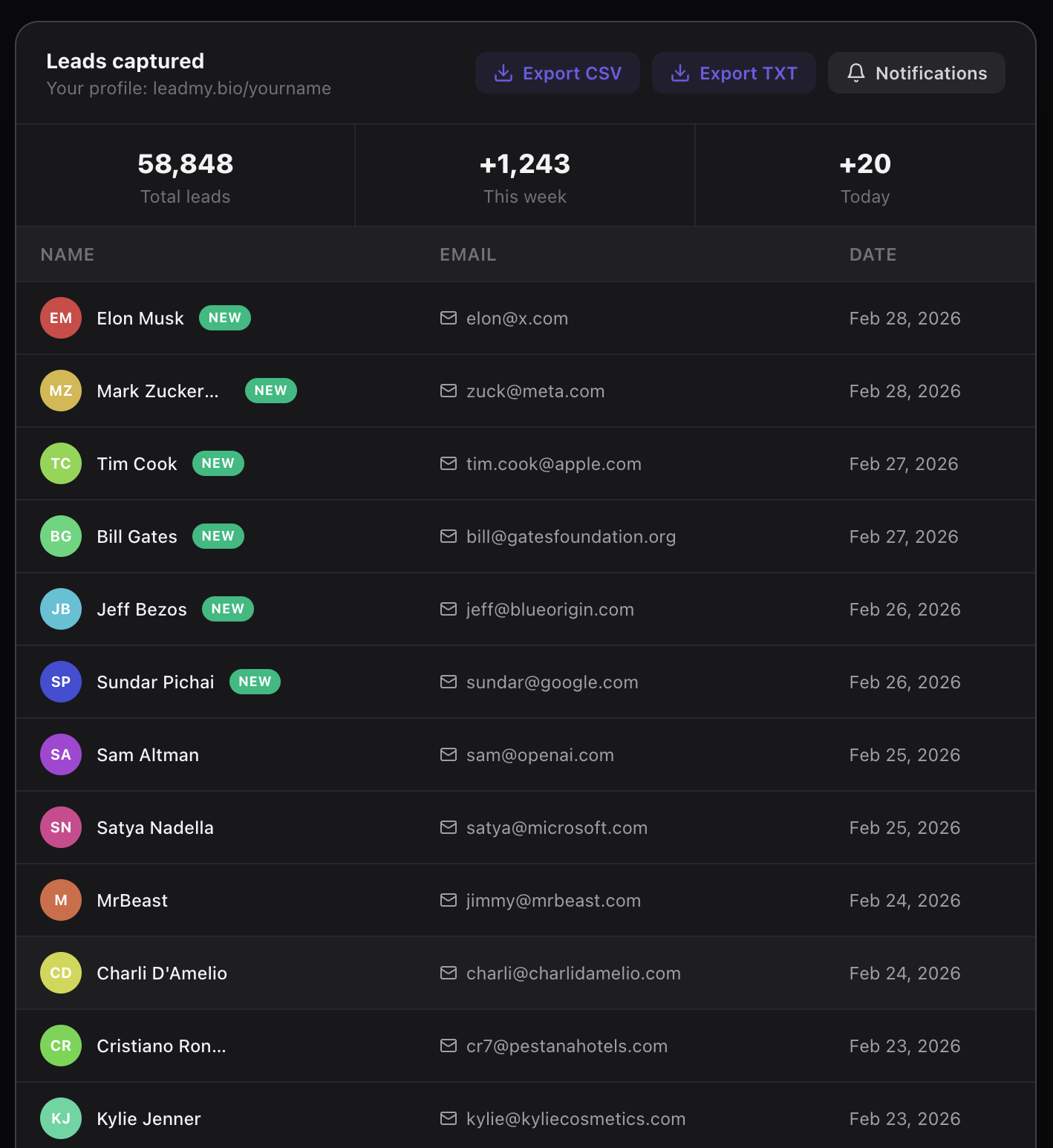
Don't wait for Spotify discovery to fall before you build the bridge. Set up email and WhatsApp capture today at leadmy.bio/login. Free up to 1,000 leads. The AI audio flood is already shipping. Your listener-to-subscriber conversion infrastructure should be live this week.
What Other Audio Platforms Will Do In Response
Spotify's move forces a response from every audio platform. The likely 2026 dynamics:
Apple Podcasts will not match Spotify's AI-generation feature, betting on its podcaster-friendly positioning. Apple's discovery is more conservative; AI-generated content has a harder time surfacing because of the curation-heavy approach. For human podcasters, Apple becomes a relatively safer growth channel through the AI flood.
Pocket Casts, Overcast, Castro, Snipd — independent player apps — will continue serving the niche audience that prefers RSS-based discovery and prioritizes smart filtering. AI-generated supply on these platforms is harder to discover because users self-curate.
Substack Audio + Beehiiv Audio — newsletter-platform audio products — will benefit from the AI flood because they're intrinsically email-driven discovery, not algorithm-driven. A newsletter writer with 10K subscribers who launches a podcast distributed via newsletter has algorithmic-bypass distribution.
YouTube Podcasts — Google's bet on video-first podcasting — will see mixed effects. YouTube's recommendation algorithm faces the same dilution risk as Spotify, but the video format (and YouTube's deeper search functionality) makes AI-only competition harder. Human podcasters with face-on-camera presence retain differentiation.
The cross-platform implication: audio creators who survive 2026 will diversify across at least three audio platforms with email subscribers as the unifying audience layer. Pure Spotify dependency becomes a strategic vulnerability.
The Discovery Algorithm Math
The math behind the discovery dilution is worth understanding. Spotify's algorithm allocates discovery surface area roughly proportional to predicted listener interest. With finite surface area and growing supply, each show's expected discovery falls.
Pre-May 7 baseline:
- ~5 million episodes per month published
- ~500 million daily active users
- Each user surfaces 5-10 unique podcasts per week through discovery
- ~2.5 billion discovery events per week distributed across 5 million episodes
- Average per-episode discovery: ~500 events per week
Post-May 7 projection (Q3 2026):
- ~50-200 million episodes per month published (10-40x increase)
- ~500 million daily active users (similar)
- Each user surfaces 5-10 unique podcasts per week (similar capacity)
- ~2.5 billion discovery events per week distributed across 50-200 million episodes
- Average per-episode discovery: ~12-50 events per week (10-40x decrease)
For an established podcaster previously getting 1,000 weekly discoveries, the new equilibrium is 25-100. That's not a slow decline; that's a step-function drop, and it happens as AI-generated supply ramps in Q3 2026.
The shows that retain absolute discovery numbers will be the ones that build platform-independent audience: email lists feeding back into engagement signals, cross-platform follower bases driving consistent return-listener metrics, paid subscribers signaling high audience-quality to the algorithm. The shows without those signals decline in raw numbers and in algorithmic priority simultaneously.
Read also: AI agents creators lead capture 2026, AI influencers replacing creators — email list defense, and GEO guide for creators in 2026.
FAQ
Will Spotify limit AI-generated podcasts to prevent platform dilution? Unlikely in the short term. Spotify's economic model benefits from supply growth (more content = more potential listening minutes). The dilution affects creators, not Spotify directly. Creator-facing protections will probably arrive only after creator exodus pressure, which historically takes 12-24 months.
Should I stop podcasting on Spotify? No. Spotify still has the largest listener base. The strategy is "Spotify + email list + cross-platform" — keep the Spotify presence, but don't depend on it for audience growth. Build the email list as the durable layer underneath.
What if I'm just starting out as a podcaster? The recommendation flips: start with email list and cross-platform from day one. Don't build for Spotify discovery first; build for direct subscriber growth from day one. By the time you have 100 episodes, you'll have an audience that survives the AI flood instead of being built into a diluting algorithm.
Are AI-generated podcasts going to be the dominant content type? By count, almost certainly yes. By listening time, no — humans listen longer to human-led conversations. By revenue, contested — AI-generated content has very different monetization economics. The strategic answer for human podcasters: own the audience relationship and let AI-generated content compete for the share of supply that doesn't have direct relationships.
Will sponsors pay less for podcast ads in 2026? On a CPM basis, yes — supply glut compresses ad rates. On a per-podcaster basis for premium creators with engaged audiences, no — sponsors will pay premium for shows with provable engagement and direct-response capability. The email list is what provides the proof.
What about platform lock-in concerns? RSS-based podcasting is structurally less locked-in than social platforms. Your podcast feed lives at your URL. You can move hosting providers. You can publish to all major platforms simultaneously. Spotify owns the discovery layer, not the content. Use that to your advantage by treating Spotify as one distribution endpoint, not the primary audience location.
How fast does AI-generated audio scale to dominate? The CLI tool launched May 8 lowers the publishing barrier to seconds per episode. AI-generated audio quality is now production-acceptable. The bottleneck is awareness: how quickly developers build automated publishing systems. Best estimates: 6-12 weeks to noticeable platform-side dilution, 6-9 months to dominance by episode count.
The Spotify Personal Podcasts launch and the developer CLI tool together mark the moment audio went infinite. The discovery economy that supported independent podcasters for the past decade is recalibrating in real time. The podcasters who survive the recalibration are the ones who own the listener relationship by email and WhatsApp. The rest will see download numbers fall and sponsorship rates compress through the rest of 2026. The bridge from Spotify follower to email subscriber is the work to do this week — not next quarter.
Sources:
- Save Your Personal Podcast to Spotify and Listen Anywhere — Spotify Newsroom
- Spotify launches AI personal podcasts feature on May 7, 2026 — Newsbytes
- Spotify launches AI podcast creation tool for developers — TechBriefly
- Inside the Creator–Tech Clash: How Spotify and TikTok Algorithms Decide Who Gets Paid — CurrentTrends
- Making It Easier for Video Podcasters to Earn on Spotify — Spotify Newsroom
- Spotify for Creators Review 2026 — The Podcast Consultant
- Spotify Creator Milestone Awards Q4 2025 — Spotify Newsroom
- Beware Spotify's video lock-in — Podnews
Ready to start capturing real leads?
Set up your LeadMyBio profile in 5 minutes. Free forever up to 1,000 leads.
Create your free profile →